So you consider yourself a political moderate: there are some issues you’re liberal on, and others you’re conservative about. So, as you might reasonably think is the right way to proceed heading into a congressional election, your plan is to assess the pros and cons of the Republican candidate, compare those with the pros and cons of the Democratic candidate, and choose the candidate you feel represents you and your community best.
Right?
Wrong. In high school government class you learned the “theory” of how our political system works: each community is represented by one congressman (or woman, but your textbook probably said man), each congressman has one vote, and the majority wins. But that’s not how it really works, particularly under a Republican-controlled House of Representatives. Why is that? Why is your vote for a moderate Republican candidate less likely to represent your interests than your vote for a moderate Democrat?
The Hastert Rule

Dennis Hastert’s mug shot
Named for former Republican Speaker of the House (plus convicted felon and admitted child molester, but that’s not necessarily important right now) Dennis Hastert, the Hastert Rule dictates that a Republican Speaker will only allow the House to vote on bills that have the support of a majority of Republicans congressmen. So while a majority of congressional representatives overall might support a bill, if less than half of Republican reps support it it won’t even get a vote.
So let’s play this out. There are 435 congressional seats in the U.S. House of Representatives. Which means that you could have Republican control with 218 Republicans vs. 217 Democrats. And let’s say there’s a bill on something that’s universally popular across America – for example, maybe 65% of Americans support something like a tax credit for medical expenses for families with terminally ill children. A bill like that would probably have the support of all 217 Democrats, but say it only carries 108 Republicans. That would mean that 325 of the 435 elected representatives in the House want to vote “yes” on that bill – nearly 75% of congress is in favor. But by the Hastert Rule, a dutiful Republican Speaker would decline to let that bill see a vote, and it would just never happen.
Now while that’s the most extreme possible example in which 25.3% of Congress can control the fate of a bill, note also that the current split of Congress as I write this is 236 to 193 (this fluctuates with representatives leaving office, special elections taking place for their replacements, etc.), meaning that as of today, a Republican group of just 119 representatives, constituting just under 28% of Congress, has the ability to prevent a bill from reaching the floor.
So what does that mean for your vote?
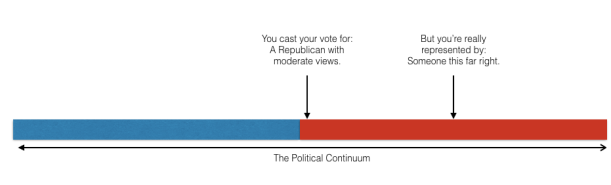
If you vote for a moderate Republican, you’re not really voting for that particular Republican. You’re voting for the median Republican, who is probably a lot less moderate than the one you’re considering in your moderate district. Your Republican representative’s moderate viewpoint will only be considered if more than half of all Republicans share that view – otherwise your representative won’t have an opportunity to vote on that issue.
(Political geek alert…feel free to read past this paragraph if you’re not a politics wonk. What exacerbates this situation all the more is that 2018 is predicted to be a really close congressional election. Meaning 1) If the GOP holds control of the house it won’t likely have more than 51 or 52% of all congressmen meaning that the Hastert standard of “more than half of Republicans” will represent a very small slice of the overall electorate, and 2) because Republicans (and Democrats, too, on the other side) have so many “safe seats” in homogenous or highly-gerrymandered districts, the median Republican in such a situation is likely to be very far to the right. Those highly-partisan districts tend to pull candidates to the extremes in contested primary races that lead to safe general elections. So consequently, if you’re in a moderate, competitive district that elects a moderate Republican in 2018, there’s a very high likelihood that your representative will be one of the 2-3 most moderate Republicans in a caucus whose median vote is further right than normal…and that median vote determines whether your representative even gets to vote for the issues and stances that won your vote.)
Now, you might be asking yourself: but wouldn’t the same thing be true on the other side if I voted for a moderate Democrat and they narrowly won control of the House?
And the answer is: no. For one, the Democrats do not honor their own version of a Hastert Rule. The most recent Democratic speaker, Nancy Pelosi, said during her tenure in response to exactly that kind of question “I’m the Speaker of the House…I have to take into consideration something broader than the majority of the majority in the Democratic Caucus.” And secondly, Republicans control the Senate and the White House, so even if they do control the House their political power is held in check, and in order for Democratic representatives to show any accomplishments to their constituents, they’ll have to support legislation that can carry moderate Republican support in the Senate.
So the sum of all this is: if you have moderate views and are still undecided or leaning slightly to the Republican candidate in your district, please realize that – through the messy machinations of American politics – you sadly do not have the ability to vote for a moderate Republican. Your vote for a moderate Republican is really a vote for the median Republican, whereas your vote for a moderate Democrat is much more likely to result in a candidate who by and large represents your interests. The Hastert Rule ensures that this is true: moderate Republicans are only able to vote for bills that their more-conservative colleagues support. So while, in theory, you might agree with your Republican candidate’s positions a little more than with your Democratic candidate’s, in practicality that Republican may not get many chances at all to further your interests.
So before you choose your candidate this November, consider the Hastert Rule and its implications. Don’t just look at your Republican candidate, think about the median elected Republican in today’s Congress – probably someone from an hour outside Omaha or Raleigh – and how much that person represents your interests. If you vote Republican in November, that’s likely who you’re really electing.
 See Me Squeegee