Archive for the ‘Uncategorized’ Category

As I write this on July 5, fires rage across the country and people find themselves without homes. Hundreds of thousands of young children and their parents have endured a month of sleepless nights, and millions of pets and wildlife creatures have spent the last month  tortured by explosions. All because of America’s love of do-it-yourself fireworks. It’s a beautiful Sunday afternoon in most of America, so quiet picnics and babies’ naps will be interrupted by Harley riders revving their engines on Main Streets everywhere. And it’s a day that ends in “Y” so at least a few children will lose their lives to stray or accidental bullets. America is not without its share of problems, but many of them stem from one simple fact:

Vroom and boom are leading us to our doom.

Here’s what I mean: a great many of our problems all stem from the combined facts that:

  1. Grownups should quickly age out of an unhealthy love for things that go “vroom” and “boom.”
  2. In concert with that, as we age we should develop more and more consideration for others and restrict our activities accordingly.
  3. But the United States is plagued by arrested development in both phases.

Let’s dig in.

Section 1: Stunted Psychological Development And Things That Go Vroom & Boom

Much like Freud has his stages of psychosexual development and acknowledges that some people can’t seem to move out of stages (e.g. an anal-retentive personality), there’s another stage that we should all grow out of but many don’t: the Vroom & Boom stage.

At some point in our adolescence through our 20s, it’s perfectly normal to love things that go vroom and boom – whether literally (fireworks and explosions, motorcycles) or figuratively (loud, angry music; look-at-me clothing; crowded places with neon lights). We’re announcing our arrival in the world – look at me! listen to my music! – and expressing our independence having spent our lives with our decisions being made for us by parents and teachers.  

The Vroom & Boom stage comes with aggressive music played as loudly as possible – a teenager wouldn’t dream of pulling out of a driveway or parking spot without the volume turned up to 11. It features bars where you can’t hear someone talk without shouting, it’s big trucks or fast cars or motorcycles and at least a few gear shifts between stoplights even if they’re less than 200 yards apart. It’s driving a few hours to get south of a state border to buy the fireworks or grain alcohol that your state deems too dangerous for human use. Whether beach or ski slope or hiking trail, it’s made better by a bluetooth speaker and as many cheap beers as you can carry.

But by a certain age – generally late 20s into early 30s – we should see our love of Vrooms and Booms decline. We’re seeking peace in our lives: the book is now better than the movie and you enjoy early mornings more than late nights. Beaches, ski slopes, and hiking trails are where you seek solitude – they don’t need a live-action soundtrack. You’d vastly prefer a reliable sedan in a muted color to a sporty car or truck with flames on the side, and sometimes you turn off the radio just to drive in silence and explore your thoughts. You lean toward sailboats versus power boats; a quiet restaurant in the Village versus a Hard Rock Cafe in Times Square; a pedal bike versus a motorcycle.

Simply put: if you’re 17 you’re perfectly justified in spending all summer trying to get on a jet-ski. If you’re 40 and that’s your summer, you’re a total caricature, like Eastbound & Down’s Kenny Effing Powers. 

HBO - Kenny Powers of Eastbound & Down at 1AM on HBO Comedy | Facebook
Things that make you go vroom

We all instinctively know this. When a man in his 40s buys a sports car or gets a tattoo, we call it a midlife crisis and look at him with equal parts scorn and pity. And if he shows up at a go-kart track without his kids or at a Spring Break bar, well, in any capacity, we look at him even more skeptically. Vroom & Boom pursuits are a young person’s game.

Which doesn’t mean we all have to listen only to acoustic sets and watch only documentaries in our 30s on our way to becoming literature professors at Bryn Mawr by our 50s to have lived an age-appropriate life. But over time, we should naturally wean off of our love of things that go vroom and boom. That graph doesn’t have to hit zero – there’s always room to relive your teenage and college passions or to enjoy flashing lights and loud booms with your kids – but unless your psychological development has been arrested in the Vroom & Boom zone, it should have a noticeably negative slope. 

Section 2: Consideration For Others

Here’s the big thing about adulthood and maturity. Your Vroom & Boom slope may be steeper or relatively flat – no matter how strange I might find you, you’re not an inherently maladjusted adult just because you really like the sound of a Harley-Davidson sputtering as you give it gas in neutral, or because you love the powerful feeling of pulling the trigger of a gun. We all, to varying degrees, have some kind of vroom and boom we enjoy – songs from college we crank up in the car while we’re alone, for example. But take heed of that phrase “while we’re alone.” Because while your Vroom and Boom line shouldn’t define you as a person, the way it combines with another, crucial trendline, is massively important. 

As we age, we should see a steep increase in the amount of respect and consideration we give to others. 

A 50-year old who still gets childlike enjoyment from watching Independence Day fireworks might come off a little weird but he’s totally harmless. But a 50-year old who spends most evenings in June lighting off fireworks – particularly in a neighborhood or in a dry area – is just a jerk. Why? Because those fireworks have negative effects on many others. Their pets or toddlers may be tortured by the sound; the debris may litter their yard or potentially catch fire on their roof, or light up a hillside and force evacuations and home losses. An adult absolutely should take those things into consideration, and the only possible conclusion a reasonable adult can draw would be “the tiny amount of enjoyment I will get from lighting a small fire and watching this object go boom is not at all worth the significant inconvenience that I will force on dozens/hundreds of my neighbors, and then once you factor in the measurable risk of injury or property damage it’s insane that I’m even considering this.” 

But, of course, across America the last month tens of thousands of fully grown men and women have decided otherwise, that their personal enjoyment of a phase they really should have long grown out of outweighs the concerns of their neighbors. And therein lies a massive national problem. Our national graph should look like this:

Where parental involvement halves the amount of damage done by that triangle at the left (my hormone-addled desire to go boom outweighs the amount that I care how it affects others), and self-restraint keeps adults in the triangle on the right. 

What should happen is that:

-Vroom-boomers who love motorcycles generally avoid quiet neighborhoods and Main Streets, taking care to quiet their engines as much as possible until they’re on the long, open road where they can enjoy the vroom without waking babies, setting off car alarms, and in general annoying everyone but themselves and the thrice-divorced career temp riding on their back. 

-Hunters live in sheer terror that their guns will fall into the hands of precocious children, so they minimize and securely lock up the firearms they own – or refuse to store them in a home where children live or visit and instead simply rent them on their occasional wilderness hunting trips far from civilization.

-The idle rich address their boredom with philanthropy or travel or really anything other than going to exotic locations to kill elephants, lions, and giraffes, knowing that the preservation of these magical animals is paramount to the pride of their local countrymen and allows for future generations to enjoy the splendor of the natural world. 

-And much, much more! We should all be governed by a healthy amount of fear that a trivial amount of enjoyment for ourselves could come at the expense of significantly more discomfort or danger for someone else. While seated the able-bodied among us should constantly be scanning our train car or the seating at our airport gate looking for the elderly or pregnant who might need a seat; while parking, we should take the spots further from the store to ensure that the prime spots are available for parents escorting young children or for older shoppers pushing heavy carts. We should take Lyft or Uber any time we’re planing to have a few drinks, we should watch our language when children are nearby, we should speak in library voices on airplanes – we should approach communal situations with an understanding that if everyone treats each other how we’d like to be treated, then it’s a positive experience for everyone.

But if American Exceptionalism is really a thing, it’s this: we are exceptional at loving things that go Vroom and Boom, and we’re exceptional at prioritizing the most marginal of happiness or convenience for ourselves at the expense of the safety or well-being of others. 

Enjoy hunting? Not my cup of tea, man – I think you can enjoy the outdoors by hiking or cross-country skiing or a whole lot of things. But do you in a way that’s safe. But of course that’s not enough: gun enthusiasts have to open-carry strut around capitol buildings and town squares and fast food restaurants frightening and intimidating real people because “I like boom so you’d better deal with it.”  

Enjoy motorcycling? Who doesn’t love the wind in our hair and the feeling of two-wheeling down an open road (you know there’s a motorless type that can help with fitness, too, but you do you) – but when you roar your engine while stopped at a traffic light in front of an outdoor cafe, it’s less about feeling free and more about just being a dick (or whatever South Park may brilliantly deem you).

Enjoy fireworks? Roll out a beach blanket and enjoy the show on the Fourth! But if your plan is to, as The Simpsons said, “celebrate America by blowing up a small part of it,” you’re putting “Me, The Boomlover” way ahead of “We The People” – that’s not patriotism, that’s selfish pyromania. 

Section 3: Vroom and Boom is causing our doom.

Now you might be thinking that loud noises aren’t necessarily doom, so where does the title come from? Think of some of the biggest problems America is dealing with in 2020:

COVID-19 (we lead the world!)

Gun violence (we lead the world!)

Police Brutality (if we don’t lead, we’re close)

Intense political polarization

They all directly related to our culture of Vroom-and-Boom. 

Gun violence really just comes down to the fact that the U.S. has long prioritized things that go boom over public safety. No other country in the world deals with anywhere near this kind of gun epidemic, but the NRA and the Republican party side with the boom over the logical. No matter the severity of the massacre, the innocence of the victims (Sandy Hook proved it: if kindergartners being mowed down by a madman didn’t lead to change, what will?), or the massive running total of the death count, the steadfast cry from the right is to never compromise, always prioritize the thing that goes boom.

Police brutality is similar – we so love things that go boom that we’ve militarized our police forces with tanks, riot gear, military-grade weapons, and an us-vs.-them mentality. And of course the police recruit largely from a pool of “people who like things that go vroom and boom” – people who want to carry guns for a living, flip the lights on and drive as fast as they want. The general sentiment in media is that the desk job of policing is for losers – the real badasses are breaking the rules on the street. We created a “war on drugs” so that there would always be bad guys to go after – rather than address the demand for drugs with counseling and medical care, we labeled it a “war” and turned thousands of wannabe Rambos into drug warriors who solve problems by making them go boom. 

As for political polarization and COVID-19 – Donald Trump is the ultimate noisemaker for people who like stuff that goes vroom and boom. Like a firework or an idling motorcycle engine, he loudly blows off hot gases with no real purpose other than to delight those who like loud, obnoxious sounds. So when he spouts off that a dangerous disease is a hoax or that masks are for the weak, the Vroom-and-Boom crowd rejoices – they get to yell and scream against masks and distancing, and now we’re the only modern country that hasn’t gotten COVID under control. And because the Vroomer-Boomers relish in the small pleasures that come at the inconvenience of others, we’ve arrived at a political chasm where compromise or even seeing eye-to-eye is impossible: like a motorcyclist revving it up next to picnickers or a gun nut open-carrying an AR-15 into Quiznos, a great many Trump supporters have no agenda other than “let’s piss some people off.” Because of course that’s the Vroom-and-Boom way.

So this weekend, as some nurse fireworks injuries and many celebrate American Independence, take note of the true meaning of American Exceptionalism. We’re #1 in gun deaths, #1 in Coronavirus deaths, and #1 in per-capita air pollution. All because, no matter who it hurts, we love things that go Vroom and Boom.

With so much hostility and division in American politics these days, I’m taken back to a day when – true story – a friend changed my mind about a political issue.  And I’m hopeful that at least some people will read this and see a path toward changing one of their friend’s minds or even their own mind.  Here’s my story:

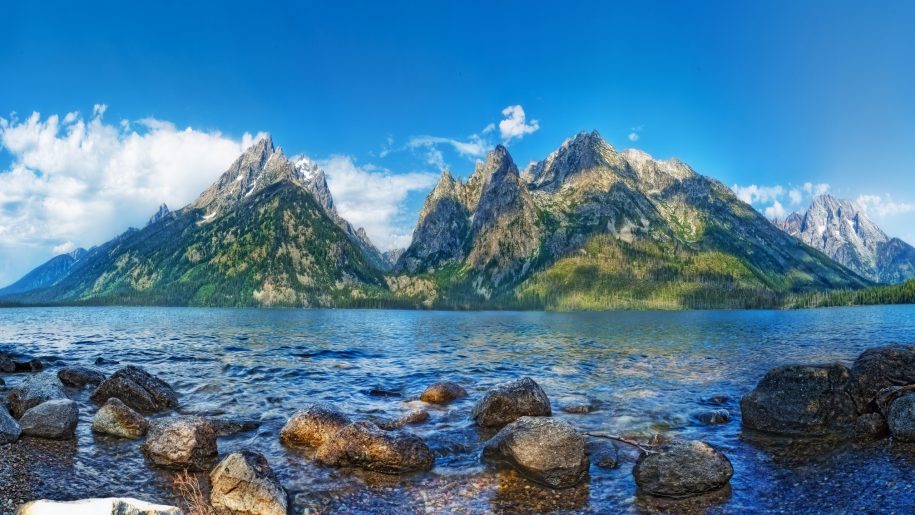
It was June of 2005 on a glorious summer day in Grand Tetons National Park.  I was on a cross-country-and-back road trip in the month before grad school started, and had picked up my college friend, Adam, in Idaho Falls the night before so that we could hit the Wyoming, Montana, and South Dakota national parks on my way back toward Michigan.

Jenny Lake

Jenny Lake: a good place to get some perspective.

At some point in the first hour or two of hiking the spectacular Jenny Lake trail, the subject of politics came up.  For background, Adam lived in (and had grown up near) New York City and was a relatively fast adopter of technology, ideas, etc.  I lived in, and had grown up in, Michigan, and am more of a slow adopter.  So while we had both voted for Kerry 7 months prior to this conversation, when the topic of gay marriage came up – perhaps because it had been a wedge issue that may have cost the Democrats a very winnable election – Adam was in favor of it, and I let him know that I was against it.

Now, it wasn’t at all the case that gay marriage was the only or even the main topic of our conversation over the next several hours of hiking.  But for a few minutes an hour, for a fair chunk of our food-and-water breaks, any time he formulated a new question to get my thoughts or I conjured up a new-and-seemingly-better reason for my stance – over the course of the day the topic kept coming up.  And to Adam’s credit he was never pushy or judgmental and he wasn’t always the one to return to the subject – he just asked questions that forced me to think about and try to defend my position.  And – spoiler alert – I didn’t do a very good job of it.

10am, hiking in shade maybe 15% of the way up the hill:

Adam: Wait are you against gay marriage in general, or do you just think that Democrats overplayed their hand?  You know Kerry wasn’t officially in favor of it.

Me: Well, both.  It definitely helped Bush that the GOP made it a wedge issue.  But I mean come on…gay marriage has been illegal forever.  Why change that now?  And why do liberals have to fight for it and risk losing better foreign policy, economic policy, stem cell research, and everything else?

Adam: Isn’t it just civil rights?  Why should it be illegal?

Me, forced to defend that position maybe for the first time ever: It’s just always been illegal.  Why change?  It’s not like anyone is saying that gay people can’t live together and love each other.  The word “marriage” just has specific meaning, a man and a woman.

Adam: Interracial marriage was illegal. Should that have stayed that way?

Me: No, man…that’s different.  <picks up the hiking pace, points out a cool view of the lake>

11am, closer to halfway up the hill, drinking water in the shade:

Me: I was thinking about what you said about interracial marriage, and of course that is and should be legal.  But gay marriage, man – why can’t it just be civil unions?  Marriage has that meaning – it’s more of a church word than a legal word.  It’s a man and a woman.

Adam: But calling it marriage doesn’t mean churches have to recognize it.  It’s separation of church and state, man – churches can do what they want, but if the government is involved everyone should be treated the same.  Right?

Me: Yeah, but it is the same – if you want to marry the opposite sex it’s called marriage, and if you want to marry the same it’s a civil union or whatever you want to call it.

Adam: So like Plessy vs. Ferguson, separate-but-equal?

Me: Come on, man – I’m not Jim Crow here.  It’s just…it’s different.  People can’t help being black, but choosing to marry someone…

Adam, interjecting: You know it’s not a choice, right? There’s scientific proof.

Me: But getting married is.

Adam: Shouldn’t everyone have access to the same choices under the law?

Me: I don’t know…this one’s just…different.  I see your point, but I just see it differently I guess.

12:30pm, almost to the top now:

Adam: So let me ask you this: even if like you say it’s different, why does it have to be illegal?  Why should we tell thousands or even millions of couples that their relationships aren’t as valid as other people’s?

Me: I don’t think we’re saying that necessarily.  We’re just saying it’s different.

Adam: So if a couple has been together for decades and one of them is in the hospital and visiting rules say immediate family only, you don’t think they should be able to visit just because they’re the same sex?

Me: I mean…they should.  They should just change the hospital rules.  Wouldn’t that fix it?

1:00pm, eating Clif bars at the top of the mountain, soaking in the view:

Adam: So other than “it’s different” what’s your real opposition?  Why does it even affect you?  Doesn’t it just affect the people who want to get married?

Me: It just…it just kind of cheapens the word marriage.  Marriage means something and has for centuries.

Adam: So drunken Vegas marriages, the huge divorce rate, the prenuptial agreement industry, reality shows where contestants meet each other and get married right away – those don’t cheapen the word marriage, but two men who love each other and want to make a commitment to each other getting married does?

Me: I mean…I guess not.

Adam: So what’s your opposition again?

2pm, picking up the pace after having stopped with other hikers to watch some bears near a stream.  (If somehow the bears get hostile, we don’t have to be faster than the bears, just faster than those families we’re leaving in our dust!)

Me, grasping at straws: You know, I guess if it’s not in a church then gay marriage doesn’t really threaten the traditional idea of marriage.  But even in the government sense…aren’t they just kind of cheating the system to reap the benefits?

Adam: What benefits?

Me: You know, like tax benefits.

Adam: What tax benefits?

Me: The benefits of filing jointly.  The whole point of government recognizing marriage is to encourage families, having children, paying into Social Security and all that.  But if gays are reaping those benefits, then we’re not subsidizing the right stuff – the point of subsidizing marriage is to encourage reproduction.

Adam: I don’t know, man – I don’t think you have much of an argument there. My dad owns an accounting firm…we can call him when we get back to the car and see what kinds of tax advantages gays are shooting for, or whether he’d advise two men to get married for the benefits.

Me, realizing that that call might not work in my favor: I mean whatever…I’m just saying.

By the time we reached the bottom of the mountain again, I had gone through essentially the same progression I had when I was a 10-year old desperately trying to justify my belief in Santa Claus. I wanted this position to be true, but there just wasn’t a good case for it other than “that’s the way it’s always been, and I like it that way” (sidenote: my “maybe there are regional Santa Clauses” was a decent attempt at justifying the logistics of the situation, but alas wasn’t to be…).  If on the way up the mountain I thought I had a good position and just needed to better defend it, by the way down I realized that:

  1. There just wasn’t a good reason to oppose gay marriage other than “it challenges the worldview I’ve developed about relationships since I was a toddler.”
  2. I was being kind of a jerk about it if I continued to hold that viewpoint.  Real people had a real, pressing interest in this issue, and I was holding on to my position solely out of convenience and reluctance to change.
  3. Even worse, I was making up “facts” to try to justify this position I had taken sort of on a whim and held to solely out of convenience.

But note – Adam never said any of those things.  He just asked enough questions and gave me enough space to realize it for myself. He didn’t confront me; he merely steered the conversation just enough that I had to confront myself.  And the epilogue here isn’t just that three years later I cast a vote in favor of same-sex marriage, but even broader than that that I learned a handful of lessons I think are really important.

Lessons Learned

  1. The woke need to be patient with the waking.  This whole conversation worked because it could take place in small chunks over a long day between good friends.  Had Adam called me names or belittled my opinions it would have made for a really rough trip and a much less receptive response from me.  But by steering me toward my own realizations, he made it so that I still enjoyed the heck out of a beautiful day in the mountains and I came to some profound conclusions.  Everyone should have the benefit of these kinds of long walks/hikes/bikes/whatever with a good friend who wants to open their mind.
  2. It’s not good enough to “have an opinion.”  It had better be an informed opinion.  What pains me the most as I look back on my opinion is that not only did I not have any good reasons for my position at the time, I hadn’t really done much thinking about it at all other than deciding “nah I don’t like it.”  Real people’s lives hang in the balance when we vote, and yet too many of us make knee-jerk decisions for no reason…or we make up our own false reasons.  There may well be good reasons to vote against certain progressive social justice reforms, but by and large the reasons you hear from people are as closed-minded and just wrong as mine were.  People shouldn’t have to suffer for your convenience or because you didn’t take the time to understand an issue before voting against it.
  3. Progressive causes are almost always right.  This one may be controversial, but much like St. Paul’s walk to Damascus opened his eyes, my walk to Jenny Lake opened mine.  Whichever oppressed, downtrodden, marginalized group is looking for a fairer shake – whether it’s gays seeking to get married or to adopt, trans people wanting to use the bathroom, blacks looking for better treatment at the hands of law enforcement, Syrian or Central American refugees seeking asylum – the arguments against them are almost always either emotional (“what am I supposed to tell my kids if their friend has two mommies?” / “do you know how hard it is to be a cop?”) or just plain made up (“these refugee children could be members of ISIS or MS-13!”).  If you genuinely consider the plight of those who would be affected and weigh that against reasoned, well-sourced models of the possible negative effects of such a policy, the negative effects seem to always be outliers whereas there are thousands, millions of people who are already being horrifically negatively affected by the current situation.  Sadly, most opponents of those positions don’t seem to even consider the facts – I know I didn’t in my steadfast opposition to gay marriage.

I write this as someone who wasn’t always “woke” – who had to wake up and realize how wrong I was and, embarrassingly for someone who considers himself smart and practical, how cavalierly I adopted and stuck by my position without being open to really thinking about it.  I urge fellow progressives to find opportunities like Adam did, to softly challenge and steer someone toward the light.  And I urge those opposed to that progress to just open your mind and consider other perspectives.  It’s not wrong to be a slow adopter, but if you know you’re a slow adopter like me it’s important to be conscious of that and to challenge your way of thinking, particularly when the consequences are largely immaterial to you but hugely important to someone else.

Diary of the Thomas Fire

Posted: December 18, 2017 in Uncategorized

Saturday, December 2: Prologue

6:30pm I drive the long way around the Main Street area to get home, having driven all afternoon back from a morning speaking engagement in San Francisco.  It’s arguably my favorite day of the year in the city of Ventura, California: the Winter Wine Walk is a big street festival during which they block off a 6-block area of Main Street and put a big concert stage at the main intersection in town, Main and California.  That intersection is one block downhill from City Hall, and about a 10-minute walk from our house.  When I arrive home we can hear the music from our open windows on a beautiful night: a mix of Christmas music, pop, and classic rock.  We walk down the hill to check out the scene, and downtown Ventura is hopping.  From 2-6pm most merchants had wine tastings, partnering with local wineries and breweries (you have to buy a wristband for $50 to partake; since I was traveling we weren’t able to).  The streets are filled with revelers, the city of Ventura kicking off the holiday season.

6:45  We arrive at California and Main.  We missed the exact beginning, but there’s fake snow blowing in the air.  For about an hour just after it gets dark the city blows snow around that intersection while the band plays.  A juggler on stilts dances to the music along with some bikini-clad Mrs. Clauses on pedestals.  Everyone is smiling, from face-painted children with candy canes to beleaguered wine walkers holding their umpteenth glass of the day.  Everyone has their phone out, spinning to take panoramic Instagrams or Snapchat stories so that friends around the world can enjoy this sand-and-snow scene.  Look uphill and City Hall is majestically lit on the hill looking down on the party.  Look downhill a few blocks and there’s the Pacific Ocean glistening in the moonlight.  This scene chokes me up every year: Ventura has everything, a vibrant, adorable downtown, the beach, the mountains, perfect weather, and even amidst that some snow for Christmas.  I soak in the scene: I’m so lucky to live here.

Monday, December 4: The Fire

8:11pm  My Aunt Joan texts from Connecticut.  “Just heard about the large fire in Ventura County. Praying you are safe and far from the flames. 🙏🏻”

We just sat down to dinner and Lindsey hates when I touch my phone during dinner.  But it’s Aunt Joan and it’s after 11pm her time so I want to at least respond.  I Google the fire – it’s in Santa Paula, a city about 15 miles away.  Most of my life in Southern California revolves around the coast: probably 80% of my commute is on roads that directly hug the beach.  I live within a mile of the ocean, and the two offices I report to are at least as close.  So while Santa Paula is 15 miles away, in my mind it might as well be Arizona – I just don’t know anything about it.  I respond “Yikes…looks like it’s a couple towns away but I’m sure we’ll be smelling smoke soon.”  We get back to eating dinner and I make a mental note to check on the fire when we’re done.  The wheels start turning: but wait…if it’s already news that people are getting in Connecticut, it’s probably a bigger deal than I’m making it.  I’d better check on this soon…I’ll eat fast and won’t go for seconds.

8:22pm  My friend Laura texts.  She lives maybe an hour away in the San Fernando Valley closer to LA.  “Wow.. I’m just hearing about the fire up by you guys! This wind sure isn’t helping either…  Let us know if you need a place to go!”  We’re just about done with dinner.  I’ll turn on the news and start looking on Twitter.  As they say, where there’s smoke there’s fire, and two texts over 11 minutes means there’s smoke.

8:25pm  I get up to rinse the dishes (I’m a great rinser!) and put them in the dishwasher.  I’ll run upstairs to change out of work clothes and then start looking into the fire.  We keep the windows upstairs open pretty much year round.  As I get halfway up the stairs the smell of smoke hits me pretty hard.  I close a window and while I have my drawers open to change clothes I grab a few things and throw them in a duffle bag…just in case.

8:30pm  Downstairs I grab my laptop and flip the channel from Monday Night Football to the K-CAL 9 news.  I tell Lindsey “it’s really smoky upstairs…we should keep an eye on this.”  She’s doing some Christmas shopping online and crafting an email to a friend of ours – the woman who owns the safari company we booked our honeymoon with – just to inquire about what it might entail to get a safari travel agent job someday.  She’s reading off proposed sentences to me and asking questions about whether my siblings would like this candle or that book.  I’m half-listening, half-watching TV, half-skimming Twitter’s “Thomas Fire” hashtag (and 100% bad at both multitasking and math).

8:45pm  The news suggests that Ventura County residents sign up for “reverse 911” service, where the county will call your phone with evacuation and emergency alerts.  I sign up for both me and Lindsey.

8:50pm  It sounds like this thing is moving pretty fast.  I tell Lindsey I’m going to go pack for real.  Upstairs I start with clothes but then realize that if we evacuate we may never get back.  I’m close to the “if you only have X minutes to take things out of the house for a fire, what do you take?” drill.  What do you take?  I grab the championship ring I “won” as a salesperson with the 2004 Detroit Pistons…that’s something I couldn’t replace and that I want to pass on to my kids someday.  I dig in a drawer for a few favorite t-shirts – the “Woo, Pig, Sooey” Arkansas shirt that I picked up 10 years ago at a family reunion in Hot Springs when the airline lost my luggage has been a family favorite for years.  I laugh a little – my brother, my sister, and a few cousins will think it’s hysterical that I made a special point to save this t-shirt from a fire.  But otherwise I’m a little paralyzed. What’s really that important to pack right now?  Do I go for high dollar value?  High sentimental value?  Practical value?  I’m not panicked yet and we don’t have any immediate need to move, so I guess I’ll think about it.

9:00pm  It’s funny how you can live in a neighborhood and not know very much about areas within 10 miles. I’m now addicted to the Twitter accounts following the police and fire scanners and posting updates.  And as they call out roads and neighborhoods that are within 10 miles of where I live, I have to Google just about all of them.  They’re issuing mandatory evacuations every few minutes now it seems, but nothing I recognize or nothing that seems all that close to us.  Reports now say that “Ventura may be affected by morning” which strikes my senses of both calm and fear – I guess we have some time, but how in the world could I just go to sleep tonight knowing that there’s a good chance a fire is on its way with us in its direct path?

9:08pm  The @CAFireScanner twitter account posts that the fire is marching west and that fire officials don’t expect to be able to stop it before it reaches eastern Ventura.  We live on the western edge of Ventura but still…that’s a little close for comfort.  The post references “Sexton Canyon Road” as the first place that the fire department thinks it might be able to stop the fire’s spread westward. I Google it…it’s not that far, maybe 6 miles?  And if that’s the FIRST place they THINK they MIGHT be able to stop it, that’s not good news.  This thing is moving fast. I need to convince Lindsey to start packing.  At this point I’m mentally committed to evacuation…it’s probably a matter of “when” and not “if.”

9:14pm Lindsey has been working on that letter for a while now.  She sends it to her sister in Seattle for a quick proofread.  She’s ready to turn her attention to the fire now.  I tell her what I’ve been reading and how far ahead Twitter seems to be of the TV news.

9:15pm Lindsey texts her sister that we’re probably going to evacuate.  She starts packing a bag.

9:30pm We’re in our bedroom putting clothes and personal items into bags.  The view from the bedroom (and from the family room below it) is what sold us on this house – you can see the ocean, the Channel Islands, the mountains, and downtown Ventura.  Sunrise is my favorite – we face south to the ocean so the sunlight starts to silhouette the mountains, then the twinkles start on the water, and for a few minutes there’s this heavenly glow as the city and the islands  “wake up.”  Some sunsets are even more beautiful, with the entire seascape lit up with that perfect hue of pink, the mountains and islands so clear and vivid.  Tonight you can barely see to Main Street, three blocks downhill – we’re clouded in a wall of smoke.  I stare for a minute or two: is this the last view I’ll ever see from this window?  I want one more sunrise, one more glorious sunset, one more street festival on Main Street with live music and a vibrant downtown piping through the window, accompanied by a cool ocean breeze. If this is the last view, did I fully appreciate the beautiful ones as much as I could? I think of the sunsets I missed watching football or staring into my phone, the Saturday morning sunrises I slept through.  I feel guilty, and sad.  Please let me have one more.

9:45pm  I’m putting things into the car now.  My duffle bag of clothes and championship ring is in there.  I put my work laptop bag in there…if I lose the house, I’d better keep this job!  I grab a handful of collared shirts on hangers and lay those in the backseat.  Beneath the hangers in the closet is a pair of dress shoes…I scoop those and throw them at the feet of the passenger seat.  It’s real now – packing bags is one thing, but putting them in the car feels like a big step.  Lindsey texts our next-door neighbor to ask if they’re packing.  They’re not as worried: the official word is that the fire wouldn’t get to us until morning, so they’re planning to sleep in their clothes just in case they get the emergency alert.  I feel a little silly: am I panicking out of nothing?  The smell of smoke is thick in the garage…I don’t think I’m overreacting.  Better safe than sorry.  Lindsey wonders: do we really need to load up the cars if the neighbors aren’t?  I think about it.  “The happiest part of my morning tomorrow will be unpacking this car” because we didn’t have to evacuate, I say.  Let’s keep packing, just in case.

10:01pm  The power goes out.  Okay this is real now.  Like I said, we can see the city from our windows.  Everything is black. It’s not just us.  We grab flashlights – Lindsey is such a great planner she knows exactly where they are!  We don’t have internet or TV anymore so it’s 4G on our phones for news.  I’m glad I used the car charger on the way home from work…I’m at 80-some percent battery.

10:15pm  Twitter says the fire has spread into Ventura.  In less than 2 hours since we learned about it, it’s made up more than half the distance from where it started to where we live.  It’s time to get serious: I grab the two suits I have in my closet, including my wedding suit, and throw them in the car.  I grab Lindsey’s wedding dress out of the guest room closet and put that in, too.  My laptop is useless right now without power…that goes underneath the drivers seat.  I realize that our garage door is electric.  My wife is a little handier than I am..I call her out to the garage and we disconnect the door from the motor so that we can manually roll up the door and get our cars out.  I keep asking myself – somewhat morbidly I guess – what would be the one regret I’d have as the flames consumed me: I should have gotten the cars out sooner?  I should have evacuated before everyone else did and traffic got crazy?  I went back into the house to grab just one more thing? What would that thing be? Let’s get it now.  We may still have a couple hours, but however much time we have is the time we have to eliminate regrets.

10:30 We sit down for a few minutes.  It’s weird – we vacillate between frenzied packing and just kind of numb paralysis.  Is this real?  Are we overreacting?  Are we reacting fast enough?   Our new king mattress is on the floor – we got spoiled with big king mattresses in our wedding and honeymoon hotels so we just used some wedding money to buy one.  The bed frame is being delivered tomorrow.  We sit there and look out the window from the ground, then lay down for a minute with Lindsey’s head on my chest.  I can’t remember if we talked about anything or just lay there.  It’s dark and we’re a little numb.  It’s a really strange feeling: Lindsey is still hopeful that the fire will pass us.  I’m committed to evacuating, wondering when we’ll have to leave.  Because of that, I want to leave soon…why wait here and regret not getting ahead of it?  She’s conscientious: she’s “on call” at work until 7am and wants to make sure she doesn’t abandon her responsibility for nothing.  I tell her we need to get up and get moving.

10:45 The fire has doubled from 5,000 acres to 10,000 acres in the last hour, and the police/fire scanners now predict it will reach Ventura by 1am.  You always hear about that “if you could only carry a few things out of the house in a fire, what would you take?” thought exercise.  This is it.  What do I want?  So many possessions seem so trite and inconsequential right now.  I don’t have photo albums – everything is digital these days so I have my laptop and my phone.  I run to the “exercise room” and grab my Ironman finishers hats, my Boston Marathon jacket – I dreamed of these things over so many hours of training.  I grab the watch that my company gave me for my fifth anniversary there: the same kind that Barack Obama wears.  Lindsey and I grab our framed wedding invitation and the painting of the elephant that we bought on our honeymoon in Africa.  She’s getting practical now, grabbing the air mattress and some blankets. I’m a little paralyzed – what’s irreplaceable?  What will I regret not grabbing?  I look at a few things: books I love, autographs, my triathlon bike, my cycling shoes. I should probably just be grabbing anything that I even consider worthy of thinking about, but some seem too big and others just don’t seem important enough.  I’m probably missing something obvious.  Lindsey yells that she has the passports and our box of mortgage paperwork.  I’m glad I married her…I don’t know that I would have thought of those.

11:05 Our neighbor texts that the fire has hit Shell Road, which is 5 miles north of us.  The fire started 15 miles east of us.  It has already covered the entire horizontal distance.  Now it’s just a matter of whether it comes this far south.  About a mile south of us is the evacuation center, the place they’re sending everyone to be safe.  But that’s a big mile: that’s all the way down on the beach, and we’re just far enough up this hill that there’s a tree-and-dry-grass-filled park right across the street from us.  That one mile to the beach isn’t very flammable, but most of those five miles between us and the fire is.  I can’t help but think that the probability is high that the fire reaches us; Lindsey doesn’t want to leave…she can see the evacuation center from here, so how can we not be safe where we are?  Our neighbor says not to worry too much: we’ll be notified when the evacuation is mandatory.  Lindsey likes that sentiment; I lobby to leave right now.

11:26 Our neighbor texts again: there’s burning by the cross.  Serra Cross is the most notable landmark in Grant Park, the park right across the street from us.  Straight uphill it’s maybe 100 yards away, but it’s steep so the walk to get there is three steep switchbacks, probably a 15-minute walk up.  The fire doesn’t have to take the switchback route, though: I run downstairs to roll up the garage door.

The hill is orange at the top.  It’s one thing to hear that there’s a fire there, but another to see it.  Ashes are falling from the sky like snow.  It’s almost pretty if it weren’t so terrifying.  I yell inside: Lindsey we have to go NOW!  She has put a few things by the door; I grab them and throw them in my car.  Lindsey…NOW!  She’s crying – she’s upstairs now for some reason and says she’s coming.  It sounds like she’s sorry that she’s letting me down by running late, like I’m yelling at her for falling behind an arbitrary schedule.  It’s not that!  I’ve just looked in the eye of the danger…it’s not me, Lindsey, it’s the fire!   She comes down, hysterical.  While she’s coming down the stairs I grab two cases of water off a garage shelf and throw them in her car.  The charging cord for my car is next to them – I throw that in her car too.  I run back inside to see what she needs me to carry.  There are candles burning – we lit them when the power went out.  If by some miracle the flames outside don’t burn this place down, I don’t want to regret letting these tiny candle flames somehow make it an inside job.  I blow out the candles, almost laughing at the irony of protecting the house from these two tiny flames while this massive fire rages a hundred yards away.

11:29  She’s grabbing her purse and putting on shoes, and I realize I need to have a plan.  “Leave” isn’t enough – what if we get separated?  My phone service is already intermittent tonight and the power outages can’t help the cell towers.  We’re taking both cars…what do I tell her to do?

“Lindsey, drive north on the 101 and meet me at the chapel where we got married,” I tell her.  I needed to pick a direction, either north or south on the freeway, and for our stretch of US-101 the “north” route really heads northwest while the “south” runs southeast.  North goes away from the fire.  And we just got married two months ago in Santa Barbara, 30 miles north…we have landmarks to meet at.  I watch her back out of the garage, and I quickly follow.  I jump out to pull down the garage door behind me (how terrible would it be for the house to survive the fire, then get robbed before we can get back?), then point the car directly at the flames before I can turn left out of the driveway to head down the hill.

11:32  It’s eerie…the smoke looks like fog and the power outage has the town otherwise completely dark.  And oh right: these blocks we’re driving through normally have traffic lights, but those are out with the power.  Lindsey is ahead of me: I hope she recognizes to stop at these corners.

11:34  I’m on the highway with Lindsey ahead of me.  I’ve been mentally prepared to evacuate for well over an hour, but this came suddenly to her.  I want to talk to her, to make sure she’s okay, that she’s comfortable driving.  I try to call her through the car, but the cell service won’t call out.  The sound system reverts back to the radio – I hadn’t even noticed that the radio had been on when I got in the car but the dropped call has now alerted me.  It’s Sirius radio’s 90s on 9 station playing Motownphilly by Boyz II Men.  This is way too peppy a soundtrack for the moment.  I consider finding something more…appropriate?  I realize that’s insane.  I turn the radio off.

11:35 I call again.  The call won’t go out.

11:36 I call again.  She answers but the call drops within five seconds.

11:37  I call again.  She answers, crying.  She can’t talk: she’s trying to call her office to tell them that she can’t be on call the rest of the night because of the evacuation.  She’s so conscientious.  I admire that for a second but worry about her multitasking in all this chaos.

11:45  There’s no fire in the rearview anymore, just darkness all around.  I’m thinking about what’s next: assuming, as appears to be inevitable right now, that the house burns down, what do I do?  I think about the homeowners insurance, how when I bought the house Farmers Insurance required a supplemental fire plan through the state of California, but then through neighbors I found a Costco/Ameriprise plan that didn’t require that.  But does that mean it’s shoddy coverage?  Will I be protected?  And if that covers the cost of rebuilding, what do I do in the time it takes to rebuild?  Do we stay in a cheap studio apartment for a year or two while we wait?  Do I move somewhere else where the cost of living is way cheaper?  Can I stomach paying a monthly mortgage – on a place I can’t live for the foreseeable future – along with rent for a place I don’t like nearly as much?  Do I still pay insurance if there’s no home there to insure, or property taxes if there’s not really any property?

11:47  I can still taste tonight’s dinner just a little bit.  Chicken cordon bleu. Lindsey made a double batch so that I could bring leftovers to work for lunch tomorrow. This fire has ruined that for me.  Dinner was so good tonight.

11:50  Halfway to Santa Barbara. It hits me that it’s 3am where my parents live.  They don’t know that this is happening: they may wake up and hear the news, but right now they’re blissfully asleep while my life is burning down.  I’m a fully-fledged adult but I feel like I’m five – I want this to be a bad dream, for my parents to tell me that it’s all going to be alright.  But I don’t want to wake them up and worry them.  In a few minutes I can sit down with Lindsey and we can figure out the next few hours.

11:55  It dawns on me that I spent a good portion of my free time the last 10 days writing thank-you notes for wedding gifts.  Lindsey was going to drop them all at the post office today.  But if she didn’t?  And they all burn up in the fire?  Will I have to write them again?!  Even if the gifts were all lost in the fire, too?  (Update: Lindsey did put the thank-yous in the mail *and* grabbed our box of gift cards before we left so that they wouldn’t be lost in the fire.  Man she’s good.)

12:05  We’re off the highway in Santa Barbara, where there’s no power here either.  The streets are pitch black, the traffic lights out.  I slow at intersections looking for either darkened traffic lights or someone else’s headlights.  We pull our cars over in front of the Presidio Chapel.  Just nine weeks ago we stood here on a perfectly beautiful day taking wedding pictures with so many people we love.  Tonight it’s just us, it’s absurdly dark, and it’s cold.  Where I stop behind Lindsey I’m only halfway into a legal parking spot.  I’ll deal with that later: I want to get out of the car and hug her.

12:08  We sit on a ledge between the sidewalk and the chapel, huddling to keep warm and to lean on each other.  Her crying has turned to a light sob, but then she breaks down again.  “I didn’t give you a chance to give you your Christmas presents” she stutters through deep breaths.  She asks if I want to know what they are, or maybe more aptly what they were.  I tell her no, that I want to wait to see if they’re still safe in the house so that they can still be a surprise.

12:09  She stands up and says something about “going back for vows.”  I feel like an idiot: in my nightstand I keep the little book with the wedding vows she wrote to me, and while I was numbly looking on shelves and tables for sentimental items, I never thought to go get those.  She runs over to her car and pulls the book out of the center console: while I was yelling at her that she had to leave the house, she had run upstairs to go get the vows.  That’s what she went back for.  I’m choked up.

12:15  It’s cold and we need to find a place to stay.  The other thing I liked about driving north to Santa Barbara is that we know some hotels here from our wedding, and if they’re already full of evacuees maybe we can at least play the “remember us newlyweds?” card to let us leave a car there so that we can go search together.  My parents had found an off-the-beaten-path (well, at least not right downtown and not obviously off the highway) motel that was a great place and a great deal, and plenty of relatives stayed there at the Lemon Tree Inn.  We make plans to drive there – only a couple miles away – and get to work on lodging.  In the dark we turn off a block or two too early and get turned around in the dark.  It’s not our night.

12:32  We arrive at the Lemon Tree and the parking lot is fairly full.  I pull into a space and jump out to help Lindsey find one, too.  I grab the duffle bag that somewhere contains my wallet; Lindsey grabs a bag or two and we head in.  The power is out, so a manager greets us with a flashlight and pushes open the door.  They’re technically full, he says, but there may be a room or two still available online at booking.com.  My phone doesn’t have service.  Lindsey is down to one bar and it’s loading really slowly.  I almost ask whether we can use the hotel internet to look…but of course the power is out.  Without access to his computer, the night manager isn’t sure how to tell whether a room is available through the web service, so to his knowledge they’re sold out.  I thank him and ask him if I can at least leave my car while we search; I’ll come back for it in the morning.  He agrees and we leave to grab some of my things and transfer them to Lindsey’s car.

12:35  The manager runs out.  “There’s one reservation that hasn’t shown up, so let’s give you that room,” he says.  I ask if he’s sure.  He replies “if they show up, I’ll deal with it then.  You guys have had a rough enough night already; let’s get you a good night’s sleep.”  He writes a “contract” on a blank sheet of paper and I sign under my credit card number.   With the power out I joke “before I sign I should ask, do your rooms have HBO?”  He walks us to our room with his flashlight.  At least we have a place to stay tonight.

12:50  The flashlight app on my phone is reflecting in the mirror so that I can brush my teeth in this dark hotel room.  In the reflection I see our duffle bags and backpacks in the shadows near the door.  This is how we live now until further notice.  I rinse the toothbrush and switch off my phone, then walk back to the bed in the dark.

1:09  Lindsey’s phone chimes.  Her phone settings don’t display the full text on the screen, just the name of who sent the text.  It’s our next-door neighbor, Lonna.  Before she logs in to her phone we pause: this is news, but are we ready for it?  Lonna says “I don’t think we have homes anymore. We’ve been sitting in our car at the fairgrounds watching our hillside burn.”

1:11  It’s real now.  We probably knew that this would be the result as we drove away, but with an eyewitness account I guess that’s it.  We’re both a little too tired to outright cry, but tears well up as we hold each other.  Tomorrow we can start figuring out what to do next.  What does insurance cover?  Where do we live while we wait that out? How long will it take to rebuild?  Can we even afford to rebuild?  Those questions occupy the outer regions of my brain, but really all I can focus on right now is that empty feeling of finality.  Wow.  It’s gone.

1:18 It’s “what if?” time.  I think back to when we toured – and loved – our house.  What if I had put in a lowball offer and been outbid? What if hadn’t been playing around on Redfin during long indoor bike workouts, and had never discovered our house?  What if I had listened to my cold feet while we were in escrow?  All these little decisions…how did they lead me to here, and how could things have been different?

1:22  It’s self-pity time.  I think of all the hard work that led to being able to afford that house – tutoring after work, teaching classes on weekends, long commutes, stressful workdays, responding to emails on weekends, holidays, vacations.  Being diligent about saving money.  Years of being hardworking, responsible, frugal…and it can all go away because someone 20 miles away flicked a cigarette butt into dry grass on a windy day?

1:25  It’s self-doubt time.  I could have stayed in a smaller apartment.  I didn’t need this house.  And yeah I think I’m responsible and hardworking but buying a house up on a hill with a view of the ocean…that’s greed, that’s indulgence, that’s wanting to have something that other people would envy.  I didn’t need that – through my own devices I put myself directly in the path of the fire.  I don’t have anyone to blame but myself.  I flew too close to the sun and literally got burned, so maybe I deserve this.

1:38  Lindsey’s phone chimes again.  It’s Lonna again.  We can’t believe it.  “Your house is fine.”  We text back.  How do you know?  She responds “we’re home.”

1:40  Seriously?  All within a half hour we go from knowing our house is gone to knowing that it’s safe, and safe enough that our neighbors – we share a wall – feel comfortable staying the night there?  Once again I’m numb.  I want to be thrilled, relieved, grateful, overjoyed.  But I just can’t believe it.

1:48  Lindsey and I both struggle with belief in God.  I wish I did – life was so much easier when I could just assume that a magical man in the sky had everything under control – but as I’ve grown up I’ve become skeptical.  Quick tangent that I think I’ve blogged about elsewhere on here, the seeds of those doubts started with the “Doubting Thomas” story in the Bible, where Thomas is the only apostle who doesn’t get to see the resurrected Jesus and is (rightfully, I’d say) in disbelief when the others tell him.  The lesson from that passage is “just believe, just have faith” with Thomas painted as “the bad guy” for not accepting that at face value, the last line “blessed are those who have seen and believe, but even more blessed are those who have not seen and yet still believe.”  And even as a 10-year old altar boy I always felt that that was the kind of thing a con artist would force on you.  It was the Wizard of Oz saying “pay no attention to the man behind the curtain” or Donald Trump saying “believe me, believe me” after every asinine statement.  So at the same time I’m living Thomas’s life for a moment – I keep asking Lindsey to ask Lonna more questions…I cannot believe that our house is still standing – and, yes, thanking God.  Maybe it’s just a habit from my childhood but when we were fleeing I was praying, God save our house, and now that it’s been saved I’m praying, thanking God.  One more tangent – I think about two men I admire a ton, Cat Stevens and my uncle.  Both, in times of crisis, prayed with the bargain “God if you save me and my family, I will dedicate my life to serving you.”  I may be a terrible person for saying this, but I’m glad I stopped short of that…I get to keep my house *and* watch football on Sunday mornings instead of going to a church that I can’t entirely believe in.  The art of the deal…

1:55  Okay I’m thrilled now.  Lindsey is crying tears of joy.  We’re hugging each other tightly – we have our home, and we got through this together.  It’s only been a few hours but it feels like it’s been a lifetime.  We got each other to safety, we helped each other through a hard time – our relationship is strong and we can handle crisis together.  That’s a win!  And after all that everything is just okay…how did we get so lucky?

2:06  Lindsey and I are still beside ourselves with relief and joy.  What a night it’s been, too emotional to just go to sleep.  I realize again that none of my immediate family back in the Midwest has any idea that any of this has gone on.  My brother wakes up before 5am Eastern – he works in a school and works out in the school gym before classes start – so he’s almost certainly up by now.  And he loves a good story.  I call him.

2:07  Essentially I’m just telling him everything you’ve just read.  His disbelief wears off quickly – those who know us know that when we get together it’s only a matter of time before the jokes and hip-hop references are flying – and we shift to celebration mode.  I quote Jay-Z “If you escaped what I escaped, you’d be in Paris getting effed up too!”  Sean has already made plans to come visit in February, so I close the call by triumphantly saying “the trip to Ventura is still on.  You can stay at MY HOUSE!”

2:20  Remember Leon Lett?  In a Super Bowl in the 1990s, Lett was a defensive lineman for the Dallas Cowboys, who were blowing out the Buffalo Bills.  Late in the game he scooped up a fumble (or maybe it was an interception) and ran over 50 yards untouched toward the end zone – a 300+ pound defensive lineman in full sprint to score an improbable Super Bowl touchdown that would put the exclamation point on a championship.  But famously he started celebrating inside the 10 yard line, holding the ball down low while strutting toward the end zone, and a speedy Bills receiver chased him down and knocked the ball out of his hand before he could score.  My brother and I love that play…over 20 years later Leon Lett is a common punchline when we get together.  And I bring this up because:

2:21  Lonna texts again.  “We’re being evacuated again for another fire by city hall.”  City hall is about a quarter mile away.  Did I just Leon Lett my own house?

2:25  Lindsey and I are exhausted.  The winds are supposed to last all week and the fire is spreading.  This won’t just be a long night, but probably a long week.  I drift off to sleep, mad at myself for celebrating too soon but optimistic, too, because I know that we survived one close call so I know it’s possible we survive another.  An hour ago I was sure my house was gone.  Now there’s a 50%? 75%? chance it’s still there…I can sleep way easier now than before.

Tuesday, December 5: The Aftermath

7:00am  Lindsey’s phone chimes.  After a night of tossing and turning she’s finally asleep, but I’m up and desperate for news.  It’s Lonna – all’s safe in the morning although there are still fires burning around town.  They’re back at home, with no fires in the immediate area.

8:00 I check the Nextdoor neighborhood social media app.  There’s a message about a fire at “the apartment building on Cedar.”  If it’s the building I’m thinking about, it’s right at the first intersection we come to every time we leave the house.  I keep refreshing for updates: an hour later I’ll hear that someone has driven by and everything looks okay.

8:45 I’m watching the local news, which is wall to wall coverage of the fire.  The weather girl is talking about the strength and direction of the winds, noting that the dry, windy conditions will last at least through Friday, a full four more days.  I look at the map on the screen: we’re at the mercy of the winds for the rest of the week.  It’s a strange feeling rooting for the winds to blow in a different direction.  With all reports accepting that 1) the fire won’t be contained anytime soon and 2) it’s going to be windy all week, the only thing to really hope for is that the winds push the flames toward somewhere else.  But every “somewhere else” puts someone else’s house in the path of the fire.  Why should they have to suffer just so that I don’t have to?  I realize that my rooting doesn’t really impact the winds at all, but all the same I feel conflicted.  I can’t help but want the winds to shift, but I can’t shake the guilt that my hopes are probably working against someone else.

11:00  After grabbing some breakfast, Lindsey and I are on our way to check out our house.  Technically we’re still under mandatory evacuation orders – really the whole city is – but we’ve heard that people are at least going to check on their homes.  It’s a quiet morning as we drive along the coast: you wouldn’t know that such a terrifying fire – one that will soon affect every inch of the coastline we’re driving – is burning out of control just a few miles away.  As we exit the highway we look at the hill we live on: it’s charred black, virtually the whole thing having been scorched over the past 12 hours.

11:05  We drive around some barriers to get on our street.  I’m holding my breath: I know that the house is still there – we could see it from down below – but I’m still not sure what I’ll see.  As we pull up our row of townhouses looks exactly like it has for the time we’ve lived here…but the hill behind us is a mess.  I count three different plumes of smoke coming off the hill within 50 yards of our street, and all but the first maybe 30 feet of the hill is either charred black or covered in ash.

11:10  We walk into the house.  It smells like a Marlboro factory and there’s ash all over the floor in the main room.  But otherwise everything is perfectly fine.  I’m glad I blew out those candles!  Although maybe not: would the house smell more like Bath and Body Works and less like smoke had I kept them going?  We do a bit of a trade: some of the essential items we brought – blankets, tissues, toilet paper – can go back in the house now that we have a hotel room secured.  But I run to my nightstand to grab my little Ziplock bag of greeting cards: mostly from Lindsey, but a few from my parents and my grandmother – it’s weird but just in case something ever happens I want to be able to read their handwriting…for the same reason I keep a saved voicemail from each of my immediate family members so that I could always hear their voice again, too – and a series of notes I’ve exchanged with my sister (whenever we’re in the same building the night before a big life event for one of us – moving a way to college, a first marathon, a wedding – we slip a note under the door of the one who has the big event. Meghan started that the night before I moved to college).  I have some gift cards and a little spare cash there, too – it could be days before the threat of random fire is gone, so with some daylight and perspective I grab the sentimental and the irreplaceable.

11:25  We’re talking to some neighbors who stayed with friends in town and are up on all the local news.  Firefighters put out our hill’s main fire sometime around 1:30am.  The little fire hydrant just in front of our house saved the day: the small unburned area of trees and grass is the area they drenched with the hose.  But that wasn’t all: embers flared up just up the street early this morning and a neighbor put it out with his own hose.  And a block over on the other street that leads up our side of the hill a few homes weren’t as lucky.

11:30  We fill up a couple buckets and head up the hill with a neighbor to dump water on the smoke plumes.  It’s smoldering ashes – nothing immediately burning – and soon we realize that all we’re doing is moving the ashes around and not really extinguishing anything.  But I still feel the need to do *something*.  I keep the bucket and start dousing the trees around the property.  I know that a few gallons per tree isn’t likely going to have any impact at all against this massive fire.  But I can’t help but try.  As I walk down the parking lot to hit another large tree I see a neighbor down the way who has connected two hoses together to reach the hillside: he’s doing the same thing, hosing down anything he thinks could be kindling.

12:00pm  Having grabbed more sentimental and valuable items, we’re ready to go back into evacuation.  For one, that’s what the fire and police have asked and with the way they saved our house the night before I’m not going to argue.  But also I think more than an hour in that house could be immediate lung cancer at this point, plus I wouldn’t sleep a wink knowing that there’s a fire within a few miles and 70mph gusts expected all night.  First we drive to the top of the hill to see the charred Serra Cross and surrounding area.  And we see…

12:01  It’s post-apocalyptic here.  Little fires burn every 20 yards or so, burning up whatever fuel is left around them.  In between are smoldering piles of ash, completely blackened trees, a mangled and partially-melted Stop sign, downed and crooked power line poles.  Those waist-high wooden posts that mark the sides of roads or parking spaces?  Nearly every one is acting like a candle right now – they’re all different heights based on how far down they’ve burned, and in the top of nearly each one is a small fire continuing to burn.  We have some bottles of water in the car: we start pouring out small fires.  I’m wearing hiking boots from my bucket trips to the hill: I stamp out a few more.  The heat is immediate even through inch-thick soles.

12:10  Before we leave town we’ll stop at Lowe’s and Target, Lowe’s to find smoke masks and Target to gear up with supplies for phase two of the evacuation.  We drive along Poli Street, the street immediately below us on the hill that runs as a foothill road along the backbone of Ventura.  Every uphill street is blocked off.  For many, when you look up you see carnage.  At one intersection a police officer is directing traffic.  As we slow we get a good look up the hill.  Within less than a mile from our house we see the ruins of several homes.  We start to cry.

1:15  Driving back from the shopping center we take Main Street, all the way down the hill.  Looking up we see fires still burning on many of those uphill streets we had passed before.  Smoke billows over the mountains.  I refresh one of the emergency websites on my phone: the high wind, high fire advisory has been extended.  This morning it was through Friday night, meaning 3 and a half more worrisome days.  Make that 4 and a half now.  As we drive we get back below our hill: we look up, happy we get to see our house again, but nervous for the second time in 24 hours that we might be looking at it for the last time.

Epilogue

As I finish this story it’s Sunday, December 17, almost two full weeks since the fire began.  The Thomas Fire is now the third-largest fire in California history, and is still only 40% contained.  Most estimates suggest that it won’t be fully out until mid-January, and that when it’s all said and done it will be the largest fire California has ever seen.

We were evacuated for a full week, having fled on a Monday night and returned on a Monday night.  Since we’ve been back, we’ve bought four air purifiers and a handful of indoor plants to try to clean the smoke smell out of the air (it’s working!), and today has been the first smoke-free day that we’ve been able to open the windows to expedite that process even further.

Had you told me that first Monday night as I was driving away that this whole thing would cost me a few hundred bucks in hotel rooms and another few hundred in air purifiers, but that I’d get to go back home in a week…shoot, I’d have taken that deal if it were 10x times the money and it took a month to get home!  We know we’re fortunate.  I mentioned those sunrises I love to watch from our bedroom: the last week they’ve had a smoke filter to them, almost like you’re looking through a thin layer of charcoal and the light pink/orange is now a Halloween-ish burnt orange with gray tint.  I cherish those sunrises all the more.

If there’s a silver lining here it’s the community.  One thing I always loved about living in the cold Midwest during the winter is that snowstorms brought out the best in a lot of people: when the weather was that bad you’d go out of your way to shovel someone’s driveway or hold the door. Here we have that right now: everyone says hello, we’re holding doors and counting blessings and asking how people are doing.  Today as I was walking into town a woman pulled up in a truck beside me and offered me a smoke mask.  I felt bad – I have a box at home and actually today was the first clear day in a while so I was reveling in the clean, breathable air – but I could tell that her mission for the day was to give people smoke masks so I took it and put it on immediately.  I stopped at a store for some Christmas shopping and commiserated with the salespeople how busy they are now since they lost a prime week of shopping while everyone was out for the fire.  I spent a little too much on #venturastrong t-shirts (proceeds go to relief charities) and some Ventura-themed gifts for Lindsey.  And I laughed with the saleswoman about making sure that I had a plan for how I’d evacuate with a particular gift the next time the fires came. We hugged goodbye and on my way outside I saw some off-duty firefighters crossing the street.  “Thank you!” I yelled at them.  They waved and smiled, then I turned at the intersection of California and Main and walked up the hill.  City Hall glistened yet again, shining bright in the sun presiding over its wounded but resilient city.  I soaked in the scene just like I did two weeks ago, looking out at Main Street and watching the sunlight dance on the ocean, the palm trees swaying in the winds – yep, those Santa Ana winds are *still* blowing – and the hustle and bustle of Ventura residents preparing for the holidays.  Then I walked home, a sentence that I hope I never take for granted again.

Ventura could use your help!  Lindsey and I have been extremely fortunate in the two weeks since the fires erupted but many of our neighbors have not.  If you’re interested, they could use your help.  The following charities are set up to help victims of the Thomas Fire here in Ventura:

https://www.redcross.org/donate/cm/californiavolunteers-pub

http://vcunitedway.org/

https://vccf.org/


Penn State vs. Human Decency

Posted: December 4, 2016 in Uncategorized

On the first Sunday morning of December, 2016, the sports news cycle is full of Penn State football talk. The Nittany Lions surprisingly won the Big Ten championship, and all the buzz is whether they deserve a spot in the College Football Playoff.

Flash back to the first Saturday morning of November, 2011 – only five years ago – when the sports world awoke to a different type of discussion about Penn State football. News was trickling out that Penn State and its (at the time) legendary coach Joe Paterno had been complicit in years and years of child abuse.

So it’s been just about exactly 61 months since the news *first* broke (the story has continued to unfold, more gruesomely and less – let’s just say now it’s  “zero”- defensible for anyone involved).  Any NCAA punishments and sanctions against Penn State have already been lifted.  Penn State has already fought and won battles to have Paterno’s wins – which had been vacated as part of the initial NCAA punishment – reinstated, and a large group of former players is campaigning to have Paterno’s status (which ironically identifies him with three words: coach (true), teacher (eh), humanitarian (bullshit)) placed back near Beaver Stadium.  Penn State even actively honored Paterno before a game this season.  And, of course, Penn State fans – defiant of any attempts to back off of the university’s unabashed love for the legendary pedophile enabler – proudly chant “We Are…Penn State” without any remorse.

Penn State should make America sick.

Now hear me out. I’m a passionate sports fan in general and a massive fan of a school in the same exact division – the Big Ten East – as Penn State. I understand fandom and fully recognize that had I grown up in Pennsylvania and not in Michigan, it’s overwhelmingly likely that I’d be a big Penn State fan.  But I sincerely believe and vehemently hope that I’d be able to compartmentalize fandom and put it in its rightful place when faced with the actually-serious issue of child abuse.

Let me put it this way: I can forgive the sins of omission, but Penn State – both the university and the fan base – is horrifically guilty of sins of commission, and those are gross and unforgivable.

Penn State’s Sins of Omission

Let’s put the issue in direct context.  No one currently at Penn State directly contributed to the sexual abuse of dozens of children in the Penn State football facilities.  It even seems likely that most Penn State football fans are not even, themselves, active pedophiles!  So once you get past Jerry Sandusky, the evil monster himself; Joe Paterno, the man with all the power to stop the abuse *and* knowledge of the abuse; and other actors within the football and university administrations who had direct knowledge of what was going on, the greater Penn State community is mainly only guilty of one thing: putting football on such a high pedestal that it was more important than such egregious and brazen acts of child sexual abuse.

Since 2011 it has become abundantly clear that Penn State football aided and abetted Sandusky’s child abuse. Keep in mind this wasn’t a rogue employee engaging in illicit activities on home, off the clock.  Sandusky used Penn State football as a way to recruit his victims and performed these horrific acts in Penn State football facilities, and when Sandusky gave up coaching, Paterno granted him permanent access to those facilities as part of his “foundation” for troubled young boys, the primary recruitment method of his victims. So if you’re part of the Penn State community in 2011, you have to at least think: 1) That’s messed up; 2) We should probably spend less attention on football and think about how our rabid fandom helped – even in small part – make this atrocity possible; and 3) If we’re still proud of our university, let’s redirect our efforts to making sure that Penn State is a leader in child abuse prevention.

Right?

If you lose a friend or family member to cancer, you use your mourning energy to start a foundation in their name to raise money for cancer research.  If you lose your license from a DUI or your job from drug issues, you help make amends by trying to educate young people on how to avoid those temptations.  So if your school/team is implicated in a massive child abuse scandal, you rally the community behind efforts to rid the world of child abuse.

You shouldn’t be able to turn on a Penn State game or Google “Penn State Football” without hearing about Penn State’s involvement in the fight to end child abuse.  A percentage of every ticket sold should go to safe houses for victims; a ribbon-style sticker should be on every player’s shoulder pads or helmet as a reminder that “if you see something, say something;” there should be a moment of silence before every game; booster groups should be raising money and awareness and overall just looking for ways to use the power of 100,000+ people at every game and a massive, passionate fanbase to help address the issue.

But I get it.  Child abuse is a nasty topic and no one wants their brand to be forever linked to pedophilia.  The school likely wants to distance its reputation so that graduates and alumni don’t wear that stain on their resumes, so that prospective students don’t decline admission because of the stigma, so that athletic recruits don’t avoid State College.

Penn State should use its power to address the issue.  It should direct some of its proceeds or donations to the school of social work or to grants for psychology research into the causes and treatments for pedophilia.  After what the Penn State community did to enable Jerry Sandusky to torture young boys, it owes the world something.  But that requires a heck of a lot of pride-swallowing, action, money, and initiative.  It’s not overwhelmingly to forgive the sin of omission – Penn State and its community have not directly acted to make amends, and while I disagree I understand.

However…

Penn State’s Sins of Commission

Instead of using that energy to make a positive difference in the world, Penn State has used the last five years to defend Paterno at all turns, resist responsibility, actively ignore the plight of victims, and ultimately just act like spoiled jerks.  Instead of rallying its resources and energy around ways to address the issue, it has used that energy to:

-Fight to have Paterno’s wins restored

-Fight to have NCAA restrictions lifted

-Hold rallies to defend Paterno and campaign for the reinstatement of his statue

-Actively honor Paterno before a game during the 2016 season, commemorating his first game as coach 50 years prior

Now, this doesn’t characterize all Penn State fans, of course.  But it’s also not an outlier fringe group of a handful of fans.  This includes former players still within the public eye, massive groups of fans, petitions with thousands of signatures…  And what is disgusting is how active it is: it’s completely understandable to sit back in stunned silence and not do anything. It’s wholly another to look at the facts and allegations of the case and decide to act to promote Paterno and Penn State football over the interests of victims, to look at autumn pastime versus decades of child rape and think “I’d better do something…to defend the football program.”

Because here’s the thing: there is absolutely no easier punishment to take than officially vacating wins.  The games still happened!  If you want to remember the 1994 undefeated season or the Orange Bowl win over Miami to win the national championship, no one is stopping you.  YouTube clips still exist, Wikipedia articles will mention those games and aggregated statistics (maybe with an asterisk), ABC/ESPN producers will still set up your games against Nebraska by mentioning the 1994 season.  The only people affected will be 10-year old boys (ahem) looking up football records in the almanac or Guinness Book of World Records.  That’s it.  You’ve sacrificed nothing, and yet Penn State fans were willing to take action to not even give up that.

I’m a Michigan fan.  I loved the Fab Five, which has officially had its 1991-93 wins vacated.  And it’s a mild bummer.  I still remember those games, talk about how much I loved watching that team…those sanctions were the easiest thing in the world to agree to as a fan.  They haven’t changed any of our lives in the slightest. And that was for a recruiting violation…not for child sexual abuse.  I couldn’t imagine so desperately wanting to see those wins in an almanac that I’d get off my couch or give up a Tuesday night to defend child rape.

Same for the Paterno statue.  At the very least his reputation is “complicated” but there’s a very high likelihood that he was a monster.  Compelling evidence exists that he knew about Sandusky’s child abuse for 20+ years and not only kept him around and didn’t say anything but actively gave him fertile recruiting ground with the Second Mile charity.  I’m not saying you have to burn your LaVar Arrington jersey or turn off the TV any time Todd Blackledge or Matt Millen is on…but maybe wait a few years for the facts to settle before you go out of your way to actively advocate for a Paterno statue.  Because even if he’s more innocent than we think (keep in mind: he’s not 100% innocent and that at least is a fact) he’s not a victim!  There are dozens of actual victims, young boys whose lives were ruined or dramatically compromised by the use of Penn State football as a tool to draw them in, earn their trust, and then rape them.  The Paterno family can soothe itself with its millions of Penn State Football dollars while it waits for history to decide Joe’s ultimate legacy; the actual victims have to live with..I can’t even think about it or try to put myself in their shoes.

So when heard coach James Franklin calls his team’s win over Ohio State a necessary step in the healing process, he’s being an out-of-touch, arrogant, jerk.  There are actual victims who need to heal; Penn State fans need to exercise contrition before anyone should feel sorry for them.  And they won’t exercise that contrition.  Their actions show that they haven’t learned the lesson at all, that we can’t let football become so big that it overshadows basic human decency.  By actively choosing to defend and promote football instead of promoting the needs of child abuse victims, Penn State fans have shown that they’re recommitted to Paterno and the Nittany Lions over child justice and just general decency.

It’s appalling that in the only five years that this has been going on, the ABC/ESPN media machine, the Big Ten, the NCAA, and most gallingly Penn State fans have so quickly made football the sole priority.  By actively avoiding responsibility and reconciliation, Penn State  football should have earned the forever reputation as Pedophile U.  It’s nauseating to see them on TV and even more so to see their fan base so happy to pretend like nothing happened.  Which maybe shouldn’t be so surprising…their hero Joe Paterno taught them that.


Two years ago my brother, Sean, made a similar – and much grander – Irish journey, which among other things elicited this incredible story:

http://irishsafari.blogspot.ie/2014/08/indiana-jones-adventure-to-tully-cross.html

(Note: Please read…not only is it much more entertaining than this current post, but this current post won’t make much sense without the context.)

Of course, when I found myself in Ireland this week a similar journey was a must. That had been the highlight of Sean’s trip; the pub had initially been “discovered” (for our purposes at least) by our good friend Rory; and part of the Irish allure has always been getting way off the beaten path away from tourists and deeper into the homeland.  This pilgrimage would of course be a day well spent.

Having learned from my brother’s adventures, I was able to avoid the bus to the wrong town and the need to hire a bike some 15 miles away. With some advanced planning I managed to reduce the commute to a 5km walk after a 2-hours-and-change bus ride, but even so the journey was part of the destination. Ireland is gorgeous!  The bus from Galway first runs along the largest lake in Ireland, then progresses past lakes and mountains to “Connemara Loop” – a road that loops around Connemara National Park.  CityLink wifi be damned, virtually no one turned on a phone or tablet…all eyes were glued on some of the most spectacular scenery in the world. The ride through Clifden to Letterfrack went too quickly, if you ask me…that’s right, rural Ireland makes you beg for more time on the bus.

Alas, while you’re walking for 45 minutes into a cold headwind to begin drinking in the early afternoon, a man is forced to wonder whether the destination is worth the journey (which is the destination itself of course, but still…).  Sean’s experience at Paddy Coyne’s was amazing, but lots of that was due to its uniqueness and improbability; would mine be anywhere near that great?  And this was a whole day affair – bus station by 8:30 to make sure I caught the 9am bus to get to Letterfrack before noon and the pub before 1, with a pretty hard 5pm cutoff to walk back for the only return bus of the day at 6:05.  If it’s closed, or they’re not all that happy to see me, or it’s just a bummer, I’d have given up a whole day simply to have a few beers alone.

The scenery continued to make it a trip well-spent; Tully Cross is on the Atlantic coast with mountains and bays and greenery abound.  And there was history to be seen, too – along the walk I encountered a subdivision that seemed horrendously out of place in the more traditional countryside – a place well more suited to Novi or Grand Blanc, Michigan.  Walking closer, I saw a sign that the entire not-completely-finished neighborhood was going to auction – the Celtic Tiger boom of the early 2000s and bust of 2008 was staring me right in the face within a mile of Paddy Coyne’s.  I felt a mixture of sad – such stark evidence of how the global recession had affected my homeland, and even more so evidence of how global corporatism had blighted this amazing landscape – and of schadenfreude: how dare those developers think they can profit off of Irish tradition and natural beauty!  And how wonderful that a centuries-old pub nearby was thriving and attracting Americans (well, three of us now that I know of) for its authenticity while the bankers and opportunists suffer just down the hill.

As I turned the corner into the small town of Tully Cross, I saw two men setting up for the coming weekend’s Mussel Fest, and they immediately smiled and greeted me.  This was the small town hospitality I was looking for!  And just beyond them the ocean gleamed below and the green mountains – including one where, legend has it, Saint Patrick himself would go to pray – were illuminated by sunbeams poking through the light clouds.  But now the moment of truth: Paddy Coyne’s.  I walked past once just to get a feel for the town before taking my place on a barstool, and then when I circled back and walked to the door it was…closed.  And locked.  And a sign nearby mentioned that “food service resumes March 15 (it was late April, so I was in luck!) from 5pm each day (uh oh…even if I can kill 4+ hours here I only have time to slam one beer before I have to hustle back to the bus or risk being stranded).”  I returned to the men setting up the fair and asked when Paddy Coyne’s would open: they both knew that Colin Coyne (son of Gerry, the owner) was “around today” and that the pub should open later in the afternoon.  I sat on a bench out front and contemplated my next move.

Hunger intervened, and I had seen another pub – Anglers Rest – a few doors down, and it was open.  I popped in to grab something to eat and wait it out. I sat at the bar and a waitress came to take my order, and a few minutes later the bartender entered and greeted me. I felt the need to tell my story:”I’m here from the States and took a bus up to Letterfrack this morning to see Tully Cross.  This town – and Paddy Coyne’s down the street – has some legendary significance to my friends and family.”  He indulged me and I told the story further “a couple years ago my brother took a crazy trip here to see a picture that our friend had left of his grandfather in the bar.  It probably sounds crazy but that was the highlight of his trip and I’m here to see it for myself.”

The bartender, Naill, smiled and said “I tend bar there, too. I remember your brother and I know exactly the picture you’re talking about.  I’m opening there at 3…I’ll take you right to it.”

I was amazed – I had been hopeful that I’d find the photo and talk to Gerry Coyne about the story, but didn’t dream that the stories would remain so significant here years later.  I described Sean and Rory to Naill and he remembered them exactly. He brought out the guestbook – from the 1970s to the early 2000s this volume spanned – and had me read looking for Rory (I didn’t find him) and sign on behalf of the three of us.  He introduced me to some regulars and we talked (mostly about Donald Trump, but also about Ireland’s current political problems of its own), and at 3pm we headed to Paddy’s.  Gerry Coyne bought me a Smithwicks and they gave me the grand tour, including Rory’s grandfather’s photo. I took a photo of the photo to send to Rory, and via the magic of modern technology I was able to text with him and relay his thoughts to the bartenders and owners he had befriended more than a decade before.

In “that’s Ireland” fashion, I struck up conversations with locals and they implored me to stay past my 5pm cutoff for one more pint (which turned into two) and they’d drive me to the bus.  They knew my family names – the Bentons from County Tipperary and the Galvins from County Kerry – and some of the histories, and in this tiny town on the edge of Ireland, I felt that sense of family and belonging in Ireland that had been my primary motivation for wanting to visit.  Thousands of miles away from any mailing address I’ve ever had, I felt at home.

Ireland, Part 1

Posted: April 26, 2016 in Uncategorized

“Norm!” – everyone at Cheers

“What I love most about Dublin is the diversity, the blend of cultures.” – Patrick Hughes, Dublin tour guide

I came here searching the former, but at first it was all the latter.  And, believe me, this isn’t a pro-Trump (or pro-Cruz) post, but I was disappointed.  Enter Seinfeld: not that there’s anything wrong with that, variety is the spice of life, etc.  But a huge part of my excitement to travel to Ireland was to discover my ancestry, to go to a place where most people were just like me.  If I wanted to see people of all walks of life gather together to bump into each other while looking at their phones walking past TGI Friday’s, I could have gone virtually anywhere else.  But here I was, Irish in spirit but more of a mutt in practice, in a city that pretty well echoed that same composition.

But travel is the primary way to spend money and end up richer.  And I did both.

As I wandered around the city of Dublin, past Thai and sushi restaurants, past bars advertising Budweiser and Carlsberg, past hordes of non-redhead, not-befreckled humans, I felt like something was missing.  And as I walked I realized what it was: my O’Bama’s Irish Pub t-shirt, of course, guaranteed that it wasn’t abject hatred of multiculturalism, but it was indeed a longing for an increased sense of belonging and exclusivity: this was the land of my ancestors, and I wanted to fit right in.  Nevermind that my most recent direct forebear left more than a hundred years ago (when the land I walked upon was still called “England,” but I’ll get to that), or that at least a quarter of my blood was non-Irish.  I – far from “pure Irish”- wanted a pure Irish experience.  So I soldiered on, and discovered:

There’s no such thing.  That “Viking Tours” duckboat I had scowled at? Perfectly at home: the Vikings are a huge part of the early foundation of Ireland.  As were the Gauls and Normans: Galway, from where I type this?  “Gaul” meant “foreigner” to the early Irish…this was French/Norman/Gaul territory in the 1200s.  So I wonder about the prefix to my last name, Galvin…  Then, of course, there are the British, who are responsible for the majority of nice-looking Irish architecture (but then again also the potato famine…Irish farms were producing tons and tons of other cash crops, but the Crown would only allow the Irish people the potatoes).  My middle name, Patrick – named after Patrick Benton – is as Irish as a name gets…right?  Except for that St. Patrick was English, and only returned to Ireland – after having escaped jail here – upon God’s request to convert and save the Irish people.

As I learned about the crooked family trees of Irish bloodlines and of my own, I thought more about my place in all of this.  Even at its purest, Ireland was the land my ancestors left because of starvation and poverty; why had I glorified it so much in my mind?  And, as with most nationalities, “Irish” is a blend of several bloodlines and influences; the Ireland of the 1000-1500 era saw immigration like the United States did centuries later.  So why my – and “our” – fascination with Ireland?

The more I get to travel internationally, the more I realize this: we’re all very similar.  I like being Irish the same way that on any of these trips I make a point to pack a Detroit Tigers hat and a Michigan shirt…I want to belong to something, and to be in a position where someone will recognize that we both belong to the same “exclusive” club. Our families and towns are a bit too small; the world itself is way too big (unless aliens attack, of course, and then we’ll all band together). We’re all looking to belong to something bigger than ourselves but smaller and more exclusive than the whole. Here in Ireland, “we” (can I say that?) identify by the counties our ancestors are from (Tipperary and Clare for me…at least I think); in the States we identify by our primary nationalities, by the colleges we went to, by the regions we’re from..

Which brings me back to my first day here.  I came seeking belonging, a place where “everyone knows my name” (and they do…I’ve seen it on buses and signs!). And I’ve found that, but differently and more so.  My Irish roots are far from “roots” – I belong here as much as I belong in Michigan, where I grew up, and in England, where I know at least some of my Irish ancestors are from. And today some locals mentioned that the Bentons – my grandmother’s father’s family that we assumed had some English origin – of County Tipperary were a Jewish family.  So my roots may extend even further out of Catholic Ireland through Protestant England to Jewish…who knows where? Patrick Benton escaped Irish poverty the way that someone farther back than him escaped religious persecution, and before that I’m sure there were plenty more instances where my ancestors moved around for a better life.  Your family lineage – whoever you may be and wherever you may be from – is probably similarly erratic.

Every time I travel to a new place, I’m reminded that we’re all global citizens, much more alike than we are different. In different places I see similarities; this time I went to a place where I thought there would be more similarities and learned about differences in my homeland and ancestry.  As I continue this journey, I’m proud to be Irish – I still need that belonging – but just as proud to be whatever else I am along the way. And while I can’t smile walking past a freaking TGI Friday’s in Dublin, I can certainly smile at whomever is walking the other direction…whether we’re long lost relatives or just complete strangers, we have a lot in common.


For most of my life it’s been simple: you support the team 100%, you root for them until the final buzzer, you hope against logic for a win and when you lose you immediately start thinking about next week or next year. Shoot, if America has a third national anthem behind “The Star Spangled Banner” and “God Bless America,” that anthem even includes the line “for it’s root, root, root for the home team; if they don’t win it’s a shame.” (It also includes some direct product placement for Cracker Jack, meaning that it really fits the American brand as a national anthem, but that’s another post altogether…)

But thanks to the team I felt the most loyal to (the Michigan Wolverines) and to the team I probably care about most right now (the Detroit Tigers), I’m questioning the notion of sports loyalty and demanding that that loyalty go both ways.  Here’s my story.

The Easy Explanation: The Detroit Tigers

I was six years old when the Tigers won the 1984 World Series and it was amazing – a magical summer from which I still vividly remember Ernie Harwell’s voice on the radio, the animated Tiger promo on TV before turning it over to George Kell, and countless evenings falling asleep watching games on TV or listening to them on the radio – I was six!! – and waking up the next morning to check the box score in the newspaper. My favorite player was Alan Trammell – he’d go on to win World Series MVP thanks mostly to a 2-HR, 4-RBI game my dad attended at Tiger Stadium, I’ll never forget – mainly because I liked the double consonants in his box score abbreviation Trmmll. We celebrated with the whole city the night they finished off the Padres – when the doorbell rang minutes after Willie Hernandez jumped into Lance Parrish’s arms after the popout to third, a neighbor dumped a beer on my father’s head and the night continued from there – and I was a Detroit Tiger for Halloween a week or so later.  Three years later we made the playoffs again, and then…

For nineteen years I really didn’t care.  The team was terrible – it set the MLB record for most losses in a season during that stretch and was really never relevant past June.  But from 2006 on I’ve been a huge fan again, ever since the team had a hot April and May in 2006 and showed some promise.  It made the World Series that year and has been back to the postseason several times since, and more importantly it’s galvanized Metro Detroit and all of us expatriates – it’s bonded together a community that desperately needed inspiration in the face of global recession and its devastating impact on the auto industry and the city of Detroit (much like, around the same time, the New Orleans Saints lifted up the Katrina-ravaged city of New Orleans…more on all this in a second).  It’s brought millions into a struggling – bankrupt, even – city and made us all feel proud.  I can honestly say that between the ages of 10 and 25 I didn’t care at all about baseball and now I’m a massive fan, and it’s due entirely to one word: the “Detroit” in Detroit Tigers.

That word Detroit is everything to me, just like the words “New Orleans” meant so much to Saints fans, like the letters “U-S-A” meant so much during the Miracle on Ice, and really just like the phrase “<Geographic Place> _________s” means to 90+% of any team’s fans. Sports are all kinds of fun, but of the reasons we truly care about any single game, the geographic name attached to “Lions/Tigers/Bears” represents a massive proportion.  Shakespeare asks “would a rose by any other name smell as sweet?” and my answer is “the Lions stink, but only by the name Detroit can they find my unconditional love.”  Offensive coordinator Romeo Crennel finds millions of Juliets by the city half of his employer’s name alone – we care because the geographic branding of sports makes us care.

And long story short, we spend time, money, and energy on that love with this part of the deal in place: Superstar Athlete X can make millions of dollars while making Billionaire Owner Y tens of millions more, just as long as while playing under the banner of “City/State/Region(I see you Patriots/Buccaneers)” they pretend to care just as much as we do.  Which brings me back to the Tigers.  We Detroiters love them unconditionally – but we’ll boo the heck out of a player that offends us.  It’s not batting average – for the most part we love Mendoza-line Alex Avila because he takes a licking for us and keeps on ticking.  It’s not salary and underperformance – we’re all pulling for Justin Verlander to discover his MVP stuff even while watching guys nowhere near his pay grade like Madison Bumgardner and James Shields light up the World Series.

But when overpriced 1st baseman Prince Fielder ends his 0-for-infinity postseason with the Tigers last season by claiming that he won’t let it bother him because he has kids and he’s on to the next thing, screw him. And when overpriced reliever Joe Nathan blows a save on a Sunday in Toronto (after the team lost on Saturday) and says it won’t ruin his weekend, screw him.  We don’t mind that you make millions off our nine dollar stadium beers and the countless in-game promotions for Belle Tire and 1-800-CALL-SAM that litter your broadcasts, just as long as you pretend you care as much as we do.

And it’s fucking easy. When things go well, say “and don’t let me forget to thank the best damn fans in the land…they really kept us going out there.”  When things go poorly you don’t even have to mention us (although it would be nice): “I let myself down, I let my teammates down (and I let the fans down) and you can rest assured that’s going to fuel some intense workouts during the offseason.”

I mean, come on guys. Everyone lies to keep the people interested in them happy. Former romantic partners say “it’s not you, it’s me.” Employers go the Up In The Air route telling us “Anyone who’s ever changed the world has been in your position.”  Politicians tell us that they’re about change and the little guy. Shoot, the strippers upon whom you make it rain make almost your damn salary lying to fans, and the best analogue to you is rockstars who love nothing more than to call out the city name where they’re playing “Helooooo, Deeeetroit” to make us think they care about the city between Cleveland and Chicago on this 85-city tour.  We don’t pay exorbitant ticket prices just to watch you play; we pay them because we think you care about us collectively like you think we care about you individually.  You know damn well we’d sell you down the river for someone with a .08 higher batting average and we know that you’d sleep with our girlfriend without caring about either of us.  It’s the illusion that makes this fun, so get on board.  You’re playing under the banner of our city, and that banner accounts for a huge part of your salary.  Act like you care.

Now, before I leave the Tigers let me illustrate this point that the city name matters so much.  For decades “they” have been saying how soccer is just about to take off in the US, and it’s only gradually begun to escalate in recent years.  Why?  In large part because great soccer players play for teams with names that don’t resonate with us. It’s not that we don’t recognize the talent of Neymar and Messi, it’s just that none of us live in Spain where they play.  It’s not even the low scoring that people complain ab out – tons of NFL games are field goal snoozefests and baseball and hockey games are often 2-1 or 3-2. We root for the teams geographically associated with where we live, which is why “Tampa Bay” (Buccaneers, Rays, Lightning) isn’t named after a city (the Tampa Bay is an inlet of the Gulf of Mexico; Tampa is a city but St. Petersburg on the other side of the Bay is also a city so they named it after the waterway to get the whole area interested), “Carolina” (Panthers, Hurricanes) isn’t named after a state, and the New York Jets and Giants aren’t named after the city/state they play in.  Teams know that their branding is massively dependent on geography, which is why they lean on the brand names of the areas they wish to serve/exploit.  Which brings me too…

It’s Complicated: University of Michigan

As I type this, a huge portion of the Michigan fanbase is rooting for our Athletic Director, Dave Brandon, to be fired.  No one is really “rooting” anymore for the football coach, Brady Hoke, to be fired because there’s no rooting to be done. He’s a terrible football coach, a dead man walking, and he’ll walk away having “””earned””” (one set of quotation marks didn’t seem enough) over $15 million for his “”efforts.””

Now, if you’re not a Michigan fan/alum you might think that the outcry is either just about football results (which are dismal) or about both football results and the handling of Shane Morris’ concussion in the recent game against Minnesota. But that’s nowhere near the whole story.  In his four years as athletic director, Brandon has seemingly thrived on antagonizing students and alumni, with his exploits, among others, including:

-the escalation of ticket prices for students from ~$28/game to ~$42/game (a 50% increase in the days of pretty flat inflation)

-the corporatization of the game experience, with in-game advertisements on the (new-ish) jumbotrons, piped-in rock music drowning out the band and students, etc*.

-overwhelming “Constant Contact(TM)” with alums and season ticket holders to advertise products, events, and donation opportunities

-an antagonistic relationship with fans (emailing fans to “avoid driving on Stadium Blvd.” to not see his new multimillion dollar ad billboard, telling fans to “find another team to support”, holding press conferences talking about how “real fans would support his decisions,” etc.

-raising overall ticket prices and seat donations to a deteriorating football product with an unappealing schedule, and burning through what used to be a decades-long waiting list for season tickets to what is now the need to huck single-game tickets for free with purchase of Coca-Cola products.

Now, the long version of all this is a tirade I’ve already given on several installments of the Buckeye Brothers Podcast (yep, I’m consorting with the enemy now looking for an outlet to express my frustration), but the shorter version is this:

I get that pro sports have pure capitalism as their master, and that they have to appeal to the lowest common denominator to maximize revenue – especially when the product itself is so often out of their control with the need for parity. With 32 teams in each league and one champion per year, all held in by salary caps and trade deadlines and the like, every team will have some down years and need to resort to gimmickry to attract casual fans via group sales stunts and overdone hype. But college should be different – even at a school like Michigan with 110,000 seats to fill, there are tens of thousands of students each year *which also* means that there are hundreds of thousands of alumni who want to relive their glory days by returning to campus.  And we just need a reason.  There are only a few “cathedrals” in modern sports anymore, but they’re magnificent – Fenway, Wrigley, Lambeau…  Sports don’t matter in a vacuum; they matter in large part because they’ve always mattered.  Go to a game at Fenway and you can feel the Curse of the Bambino, the almost-but-not-quite games of the 70s and of 86, the Splendid Splinter and the comeback in 2004.  Fenway is as much a part of Boston history as the Freedom Trail now, just as Wrigley is a part of the Chicago experience and every Wisconsinite or Yooper has a pilgrimage to make to Lambeau.  And in that vein, almost every Michigan alum wants to get back to campus now and then and the Big House is a centerpiece of a visit, the reason to come home (um…homecoming).

And here’s my point – Dave Brandon has squeezed alumni and students both to maximize 2011-14 profits, but in doing so he’s taught us a very important lesson, even while he represents a nonprofit.  We’re customers to the university, not stakeholders or members of a community.  And like Eve biting the apple, I think most of us can’t un-learn that lesson.

Is it prices?  Probably not specifically, but those straws have been building on our camellbacks.

Is it piped in music?  Not really, but like Steve Harvey says about too many instructions at events “Get Louder?  I spent $80 on these tickets…motherfucker you get louder.”  The college experience has always been about the whole thing – the band, the students, the campus; if you want to be a pro experience, keep in mind that the pros are all better athletes.  We like college for different reasons.

Is it the advertising? Again, not really, but I remember working with Brandon’s predecessor, Bill Martin, who told me casually one day in 2001 that the university had been offered “seven figures” for an “understated logo” on the scoreboard by one of the Big Three automakers. A recent business school grad I wondered why we wouldn’t take that, especially knowing that ads would someday come so the opportunity cost of that money was especially high in light of the fact that someday that no-ads policy would be broken. And he explained to me that the Michigan experience was about the whole experience and not just pimping out football, that financially that decision would make great sense but the goodwill it would burn with fans may not be worth it.  And what I read into that was that it wasn’t about short-term revenues but more about long-term community.  Dave Brandon’s motto – he’s said this – is “if it ain’t broke, break it.”  Which is great if you’re a CEO looking for credit for a rebuilding project, but kind of awful if, four years later, you’ve alienated extremely loyal fans, ruined a waiting list to even buy your product, and all the while presided over the deterioration of that product itself.

And to the main point of this post itself – Brandon has burned an insane amount of loyalty.  The amazing thing about “sports marketing” is that teams have to rank among most loyalty-driven brands in the world. There’s simply no replacement for Michigan for me – I either love and care about Michigan football or I don’t care about college football at all. I grew up in Michigan and went to Michigan…that’s it for me, and the same goes for Alabama fans with the Crimson Tide or Texas fans with the Longhorns. If I like cola and Coke pisses me off, there’s always Pepsi.  If I like McDonald’s and they screw me over, hello Wendy’s.  But I’ll never love Michigan State or Ohio State or even UCLA near where I live.

All we ask as fans is some loyalty in return, even if it’s loyalty masquerading as “customer retention protocol.”  And I think we deserve it – Dave Brandon is (for the next couple weeks) using the name of the university where I earned two degrees and spent some of the best years of my life.  Represent that name well.  The Tigers, Lions, Pistons, and Red Wings are playing under the banner of the city where I grew up, the city that I love.  Pretend you care about it too.  Yeah, we fans are customers but as long as you let us think we’re community members we’ll provide you with every marketer’s dream – undying loyalty and zero probability of switching brands.  A little loyalty in return, please.  The ball’s in your court.

By now we all know about Donald Sterling’s comments, and one of today’s biggest story is a brewing controversy regarding Mark Cuban’s discussion of them, in which Cuban admits to being a little prejudiced in his own life.  Most notably – but I’d argue certainly not most importantly – Cuban mentions:


“I mean, we’re all prejudiced in one way or another. If I see a black kid in a hoodie and it’s late at night, I’m walking to the other side of the street. And if on that side of the street, there’s a guy that has tattoos all over his face — white guy, bald head, tattoos everywhere — I’m walking back to the other side of the street. And the list goes on of stereotypes that we all live up to and are fearful of.”


Why not most importantly?  Because this is Cuban’s entryway to a real, substantive discussion on race, as he immediately adds “I know that I’m not perfect. I know that I live in a glass house, and it’s not appropriate for me to throw stones.”  In his comments, Cuban opens the issue in a critically important way – no one is perfect when it comes to discrimination – be it race, nationality, gender, sexual preference, disability – and so while we all relish the opportunity to point the racist finger outward at someone like Donald Sterling (or Duck Dynasty or Cosmo Kramer), we often do so at the expense of a self-aware look inward.

To me, Cuban’s comments open up two extremely important points about discrimination:

1) As a nation we’re far too quick to point the finger outward at “trivial racism” (or discrimination) and that distracts us from the real issue of real, hurtful, discrimination.

2) In our rush to attack someone like Cuban for his introspective, candid comments, we set progress back immeasurably.

Now, before I dig in, let me give the typical white, heterosexual, middle class white guy disclaimers: I’m all of the above, and especially since I’m writing because of the aftermath of the Mark Cuban “controversy” I should know better than to insert my own opinions and experiences when it comes to a discussion of race/gender/sexual-identity. I have black, gay, and far too many female friends (you could easily call me the mayor of the “Friend Zone”); I’ve hired members of all those communities and several more; and, like Cuban, I’m not perfect when it comes to prejudice.  But I try – I’ve taught in urban public schools and been a featured speaker at (Women/Blacks/Hispanics) in Business conferences, and as I’ll explain later I’ve done a lot of listening and learning, particularly as an adult, when I’ve gotten to interact with different cultures.  So with all those “I love _______ people” disclaimers, let’s tackle point 1.

1) Pop Culture Racism Outrage Is A Smokescreen

It’s almost a biannual tradition now – about every six months, someone borderline-famous says something horrifically racist and we all get to point our fingers and proclaim – yell it with me now, America – “RACIST!!!!!!!!”  And in doing so we feel great about ourselves.  Take *that* Riley Cooper / Paula Deen / Cosmo Kramer / Don Imus / Donald Sterling! You’re racist, and since I so clearly recognize that fact that must mean that I’m not.  Shame on you, good for me.

As Americans, we love our opportunity to point that racist finger. We all get to feel good about ourselves, the media get their Nielsen ratings and pay-per-clicks, some 1%-er loses their endorsements, and rednecks and Westboro Baptists get to try to improperly apply the First Amendment to public opinion (and not to government punishment).

But at what expense? In doing so we take ourselves back thousands of years as a culture.

The origin of “scapegoat” comes from an actual goat – in ancient Syria, centuries before Christ, the tradition was to load up a goat with all the sins of the community and cast that goat away, taking with it the sins and regrets of the people.  And isn’t that what we do every time we chastise a racist celebrity?  We’re all guilty of some kind of prejudice, of some kind of stereotype, of some kind of discrimination however inadvertent or subconscious it may be.  But when we get to pile that on the back of Donald Sterling or, for today, Mark Cuban, we get to blame and look down upon someone else and absolve our own sins.

Which isn’t to defend these idiots, but rather to say that they’re essentially just idiot pawns. Donald Sterling’s comments don’t really affect anyone…but Donald Sterling’s hiring and rental practices did.  Riley Cooper using the N-word at a concert didn’t really hurt anyone – but voter registration laws in that same city of Philadelphia sure did.  It’s easy to get angry at a word or a phrase, but as our moms – black or white – said, sticks and stones may break our bones but names won’t *really* hurt us.  They just distract us from the voter ID laws and discriminatory hiring and housing policies that hold back generations of people.

Which brings me to point 2:

2) In our  zeal to yell “Prejudice!” at anyone but ourselves, we preempt genuine discussion and understanding.

Let me start this with a story – ten years ago I would have almost certainly voted against gay marriage, and would have been offended to see a man kiss another man during the NFL Draft. Six years ago I voted in favor of gay marriage and last week I was happy for Michael Sam when he was drafted and celebrated with his boyfriend. What changed?  A gay coworker named Mark and, years later, a gay colleague named Kevin.  Both could sense that I was a little uncomfortable with “gay,” and both handled it with humor.  I worked with Mark at a part-time job at the “Package Pickup” (which would be a great name for a gay bar…he’d have loved that joke) desk at the Hudson’s store at Briarwood Mall in Ann Arbor. Mark loved to page me on the walkie-talkie and send me to “Women’s Intimates” where he and often another friend would watch me walk around uncomfortably trying not to stare at lingerie or pretty girls about to buy some, and then they’d jump out from behind a rack and laugh.  Kevin – who worked for me in Chicago while I was at headquarters in LA – would always jokingly let me know when he and his friends were headed out to Napa or San Francisco for a “boys weekend” and let me know they’d save room in the hot tub for me.  And both guys would ask me questions about football and mention girls they knew that they thought would like me and ultimately were just looking for common ground.  And I appreciate the heck out of them for it – I was a little bit of a bigot in regard to the gay thing, largely because I just didn’t know much about or deal much with it.  But once I got to know individuals within that community, and once they were patient and accommodating and had a sense of humor about it, it was impossible to discriminate or feel any ill will.  I became gay-friendly because the first few gays I knew were friendly.

I was able to grow in my tolerance because they were tolerant of my ignorance.

Fast-forward to Mark Cuban’s comments today, and the backlash from many:

-Why did he mention hoodies? It’s racist to summon Trayvon Martin.

-Why did he equate hoodies-and-blacks with tattooed-skinhead whites? That’s racist.

-Why would an NBA owner admit to racism in the Donald Sterling aftermath? We need a unified front to rid the NBA/world of Sterling.

Now, I don’t want to put words in Cuban’s mouth especially while I’m defending him, to an extent, from others doing the same. But in relation to point #1, as we rush to attack any potential perceived racism in his comments we lose the subtlety and potential progress in his intent. Was he wrong to “equate” hoodies with skinhead tattoos? Maybe to the naked eye, but I’d argue that his intent may have been to create that dichotomy for effect – he was *admitting* to being a bit stereotypical, so it fits his agenda: “a young black man in a temporary fashion choice may well frighten me just as much as a scary white guy who’s made some intimidating permanent life choices”.  If you’re admitting a bit of personal shame in your prejudice, that’s the kind of thing you’d admit.

And I say this less as a white guy and more as a Democrat who worries about our mirror-image-of-Tea-Party fringe: I learned in college – at a very liberal university that pushed liberal viewpoints in many social sciences / humanities classes – if you’re a member of the majority (be it male, or white, or heterosexual, or all of the above) in a discussion about issues related to the minority, just don’t say anything. Like Cuban today, if you don’t perfectly articulate exactly the point that you want to make and nothing more, you run the very real risk that your comments will be dissected and maybe distorted to make you look like, at best, privileged and out-of-touch, and, at worst, a bigot or a racist.  Now, let me balance that – there’s a ton of value in being forced to listen and a ton of value in having to really consider alternative points of view. But my experience tells me that such a charged environment of “gotcha racism” leads to resentment and exclusion, and that a culture of acceptance – of the disenfranchised minority and of the ignorance of the majority, particularly if it’s rendered humbly and in the spirit of curiosity and tolerance – can allow us all to grow and learn.

Sadly, as reaction to Cuban proved today, we’re still mired in “gotcha racism” often at the expense of addressing and changing the real, underlying, crippling racism that holds people back. We lambaste those who say the N-word but in doing so we take our eyes off of employers that don’t give black applicants a fair look. We attack for an unbalanced hypothetical comparison those who admit to racism and to a desire to learn but we don’t address the inequality in access to quality schools or pre-K education. While we scapegoat reality show celebrities and C-list disc jockeys, we ignore the institutional discrimination that comes from repealing sections of the Civil Rights Act, from continued attempts to restrict the vote, from political campaigns and slogans designed to paint minority and female candidates as “outsiders” and “not true Americans.”  We love a good controversy, but in doing so we ignore real progress.

Donald Sterling is an idiot, but he’s also a senile old rich guy whose days of real discrimination – through housing and employment – are behind him. He’s irrelevant, yet he’s headline news.  While we pointed our fingers directly at Sterling, one of his colleagues, Mark Cuban, dared to point the finger back at himself introspectively to really address the discrimination that lies beneath.  For his doing so, he was roundly criticized.  Who’s really holding America back?

“What do you say when people in L.A. ask you about Detroit?” he asked.  We were standing in the kitchen of their new house in Detroit’s north suburbs, me, my best friend from high school, Justin, and his wife, Lindsay.  He knew the answer even if neither of us could articulate it well in words.  You could say that he wanted Lindsay to hear the answer, but we both knew that wasn’t really possible either.  As I cocked my head back in thought, searching for words that may never have been invented, I couldn’t help but smile a big, authentic, involuntary smile.

“See?” he asked his wife.  And then we were all smiling, thinking the same thing.  Home.

I wasn’t more than 4 or 5 years old, in the waiting room of a doctor’s office reading what I think was a Dr. Seuss book but it could have been something similar…there was definitely a playful tone to it and it rhymed, but there was a touch of sarcasm to keep the parents engaged too.  My mom was with my brother for an appointment and I had figured out how to read enough by then that I could entertain myself in the corner.  It was an alphabet-style book, one of those A is for _________, B is for ________ kinds of things.  And I don’t know if it was C is for Caribbean or H is for Hawaii or V is for Vacation or whatever it was, but the joke on the page was to the extent of “oh the places you’ll go…but you’ll probably never go to these exotic places.”  I don’t remember too much, but I’ll never forget the punchline:

“Maybe someday you’ll go to Detroit.”

That may not have been the exact moment that I realized that the city I lived in, the only home I really knew, was a national punchline, but that was my first brush with hard-hitting sarcasm and I had no choice but to realize what it meant.  Couple that with my dad’s Detroit Marathon t-shirts that said “Say Nice Things About Detroit” and Channel 4’s “Stand Up and Tell ‘Em You’re From Detroit” ad campaign and it wasn’t too long after I started reading that I was able to tell that Detroit had a bad reputation, one that we as Detroiters felt we needed to defend against.

At the time I didn’t understand why anyone would have anything bad to say about Detroit.  I liked my school.  I liked my friends.  I liked long summer days when it’s light out until 10pm because we were on the western edge of the eastern time zone.  I liked fall when leaves fell from the trees and you could rake them in a pile and jump into them.  I liked winter when you could ice skate on frozen ponds and sled down snowy hills.  I liked spring, when everything felt fresh and new again and 50 degrees felt like midsummer.  I liked watching Billy Sims and the Lions and Isiah Thomas and the Pistons and listening to Ernie Harwell call Tigers games on the radio and going to Tigers games at old Tiger Stadium – parking next to the old Firestone building and walking across the brick section of Michigan Avenue in Corktown and seeing the immaculately cut grass in the outfield and the Olde English D everywhere.

Now I get it.  You could argue that Detroit has terrible weather. It’s a fact that Detroit has a scary crime rate (I chuckle at NYC native Jay-Z’s lyric “I’m from the murder capital, will we murder for capital” – no you’re not, Jigga…it’s us, St. Louis, or DC. Not that I’m proud.).  It’s a fact that the Detroit has declared bankruptcy, that it’s losing population faster than its Lions can lose games, that its public transportation system is worse than – gasp – Los Angeles’s, and that, yeah, that it’s a punchline for anyone who isn’t from there and for a lot of people who are.  When I was 17, my friends and I drove down to Atlanta for the Olympics, and one day we ended up a little lost in a pretty rough neighborhood and a tough-looking, bigger-than-all-of-us guy noticed and came over to confront us with what looked to me at the time like a pretty sinister smile.  “Y’all look lost,” he said.  “Where y’all boys from?”  When we replied “Detroit,” he stepped back and said “whoa!”, clearly at that point kind of kidding, but that’s our reputation.  In a world where image is everything, Detroit has an unshakably bad image.  But home is where the heart is.  There’s no place like home.  I can only “say nice things about Detroit” as the t-shirt taught me.

You know about Detroit’s crime.  You know about Detroit’s bankruptcy.  You know about Detroit’s reputation.  I want to tell you about Detroit, my home.

How can I best describe Detroit?  A couple years ago I dated a girl whose sister had Down Syndrome.  And when she’d talk about her sister her face would light up with a giant smile, that same big, authentic, involuntary smile I get when people ask me about Detroit.  And what I took from the way she talked and smiled and laughed and felt about her sister was this – it was in no way contrived or fake joy; it was in no way pity directed at her sister.  It was a combination of pity for those who could never get past the surface of her sister to fully recognize and appreciate how wonderful she was, and joy that she herself was one of the few people who got to fully enjoy such an incredible person.

I feel pretty similarly about Detroit.  For those of us who grew up there, who call it home, Detroit is a great place that we both regret that no one will really understand and that we secretly love that it’s *ours*.  It has its problems, far too many to name in one blog post, and it will never have the outside allure that Paris and San Francisco and Miami have.  But it’s home, and it’s the only place I’ll ever call that.  Welcome to my Detroit.

October, 2006.  Venice, California.  My brother and I are at a bar watching the Detroit Tigers in the World Series. I’ve lived in Los Angeles for two months; he’s visiting.  To our left is a Venice Beach drug dealer; he’s wearing a navy blue hat with an Olde English D.  To our right is a real-life Axel Foley from Beverly Hills Cop.  He’s a Detroit homicide detective on vacation in California; he’s wearing a navy blue hat with an Olde English D.  All four of us are.  I ask the cop what part of Detroit he’s from and he tells me Brightmoor, a notably rough section of the city that may well have the highest murder rate.  Now I know what’s coming next and I’m a little embarrassed.  I’m from the suburbs, a New England looking middle class town called Plymouth, about 15 miles from the city limits of Detroit.  “West suburbs,” I reply.  “Plymouth, out by Ann Arbor.”  It’s only in my head but he looks at me a little funny; earlier in the conversation I had definitely said I was from “Detroit.”  “But out of town I always say Detroit,” I follow up.  A little drunk and a little embarrassed I meekly ask “is that okay?”.  Shaking my hand with a big smile on his face he says “Preferred.”  

They say that it’s not where you are that counts, but who you’re with. And that’s the main reason I love Detroit.  As I type this – on an 80-degree January day in Los Angeles – I’m wearing my “Detroit vs. Everybody” sweatshirt.  There’s pride in being the underdog – we’re all in it together.  When I see another Detroit Tigers hat here in Los Angeles, it’s just instinct to smile and say hello and know that it’s coming right back to you; when I’m home in Michigan everyone says hello or good morning and if there’s any reason to be collectively happy – a nicer day than the day before, a win for a local team, a great live band – you’ll comment to a stranger about it as you pass on the street or hold open the door.  It took leaving Detroit to realize that that’s not always the case, that it’s normal for neighbors to avoid eye contact, to not share in the joy of a gorgeous fall day or a major triumph for a local entity.

This summer I was back home and my dad and I rode racing bikes from Plymouth down Hines Drive – a 25+ mile park system that runs through Wayne County – into Detroit, a couple suburbanites in lycra doing yuppie things.  At Outer Drive, entering “actual Detroit” some construction workers were paving the shoulder and working caution and Stop signs to control  traffic in a single lane.  As we rode through, a native Detroiter shifted his Caution sign to his other hand to hold up a high five – “you’re doing great…go get ’em!” he yelled as we slapped hands.  Total strangers from different worlds united by a beautiful day and civic pride, compelled to share that enthusiasm together.  That’s Detroit.

A couple weeks ago I was home for the Christmas in an incredibly cold couple of weeks that culminated in the Polar Vortex.  Through family some free tickets came through for the Old Timers game of the NHL Winter Classic – an outdoor hockey game in 10-degree weather in downtown Detroit.  Downtown was packed; people dressed as warmly as they could and threw caution to the wind, for there was a big event with local legends and as the song goes there ain’t no mountain high enough, ain’t no vortex cold enough to keep Detroiters from a big gathering of fellow Detroiters.  As we eventually dodged the crowd a little early to get to a midtown microbrewery before the rush, my family took a moment to soak it all in.  Tens of thousands of people spending all day outside on one of the coldest days of the year, just to be together for a game that didn’t even count.  That’s Detroit.

I currently live in Los Angeles.  So does just about every celebrity in the world, with the remaining fraction living in New York or London.  You know who doesn’t?  Eminem.  Kid Rock.  Bob Seger.  The Detroit crowd stays home.  Even our prodigal daughter, Madonna, has been adamant that she wants to send *her* daughter to the University of Michigan.  And while we’re talking music consider the example of “Searching for Sugarman’s” Sixto Rodriguez.  He was Bob Dylan at the time when Bob Dylan became Elvis Presley, but when he didn’t get the breaks he rolled up his sleeves and worked construction and demolition.  And he was happy.  40 years later he’s a world-famous touring musician for songs that Sixto wrote in the Sixties.  And he hasn’t changed a bit.  That’s Detroit.

It’s not surprising that the owner of the Detroit Tigers and Detroit Red Wings, Mike Illitch, continues to buy up real estate in Detroit to rebuild downtown.  He’s responsible for much of the riverfront development near Joe Louis Arena and he basically created the “Foxtown” area a few miles north on Woodward, buying the Fox Theatre and then building Comerica Park for the Tigers across the street, leaving space for the Ford family to build Ford Field next door.  But do you know which NBA owner is buying up Detroit real estate like an ADHD Trump?  Not from the Detroit Pistons – it’s Cleveland Cavaliers owner Dan Gilbert.  Why? Because he’s from Metro Detroit, and Detroit needs an infusion of capital and entrepreneurial spirit. Some people dream of becoming billionaires to offshore their money and vacations to the Caymans; some people dream of becoming millionaires to invest in Detroit.

Detroit does common good.  While local American governments were turning firehoses and Dobermans on African-Americans during the Civil Rights Movement, Berry Gordy used Detroit as a launching pad for Motown Records, sending the sounds of Smokey Robinson and Aretha Franklin and Stevie Wonder through the airwaves as an example of what could be.  When FDR signed the Lend-Lease Act in 1939, tying the fate of a nation in Great Depression to the fate of the western world in World War II, the Detroit automakers converted operations into the Arsenal of Democracy, producing the artillery to win the war and manufacture the nation out of depression.

My city is no stranger to bankruptcy; in the 1980s one of the Big 3 automakers – Chrysler – flirted with it as the country exited the oil and inflation crises of the 1970s.  Chrysler responded by introducing the mass market to the minivan and the SUV (also the K-car, but let’s not talk about that).  More recently one of our decorated athletes – basketball star Derrick Coleman – went bankrupt, and not in the humiliating way that many hoop stars lose it all.  Derrick took the money he earned as a star with the Nets and 76ers and other teams and made a goal – invest in just one block near his old house and try to revitalize the neighborhood with a restaurant, a convenience store, an arcade, a video store.  It didn’t work, and DC lost about everything, but he tried. You may say he’s a dreamer, but he’s not the only one.  When Detroiters get money, we try to reinvest near home – Gilbert has his buildings, Illitch has his, Jalen Rose has his Leadership Academy, Kid Rock bought the “Made in Detroit” brand to keep it going.  And I have my “stimulus plan” – my friends laugh but when I go home I like to spend a little extra money.  Nothing extravagant, but if I should get a haircut I’ll wait a few weeks to time it until I can get it in Michigan; if I need to buy socks or underwear I’ll time it to buy in Detroit.  And when I’m with friends at a bar or restaurant I love picking up an extra round or a tab with money not earned in Michigan – my little stimulus plan to add a little something to the local economy.  Again, you may say I’m a dreamer but I know I’m not the only one.  That’s Detroit.

On Eminem’s most recent album he dropped the lyric “Maybe that’s why I can’t leave Detroit; it’s the motivation that keeps me going.  This is the inspiration I need; I could never turn my back on a city that made me.”

Kid Rock’s best quote, from when he was asked why he broke up with a supermodel girlfriend, was “Some people like to drink champagne in Paris; some people like to drink Budweiser in Detroit.”

But maybe it’s an obscure Kanye “Mid” West (he’s from Chicago) lyric that summarizes my feelings about Detroit most.  He’s talking about the black community – “black excellence, baby” is his refrain – and even if you’ve heard it this line is pretty forgettable other than the sincere, genuine emphasis with which he says it and emphasizes the collective noun:  “I love *us*.”

I’ve tried my best to defend the weather and I truly believe it’s a good thing even if took moving to perma-summer to appreciate it.  And other parts of Detroit are even harder to glorify to outsiders – the crime and corruption within the city, the bankruptcy, the population and migration trends.  But Detroit is more than socioeconomic statistics and global manufacturing trends and sociological research.  Detroit is people, and it’s some of the friendliest, most sincere, most hardworking people in the world.  I love us.  I love Detroit.  There’s no place like home.

Ironman

Posted: November 17, 2013 in Uncategorized

October 25, 2013.  8 days before Ironman Florida.

Markus (my boss, who’s fascinated by endurance sports training programs):  So…your last weekend before the race.  You’re tapering – what are your workouts this weekend?

Me: I’ll back off to one workout a day and relatively short.  Probably a 14-mile run on Saturday and a 2 or 2.5 hour bike on Sunday.

Markus (laughing): I see those 13.1 stickers everywhere.  You realize that people put stickers on their car for doing your taper workouts, right?

This is a tough post to write.  People have asked me to write about Ironman and I’ve never been sure how to write it.  Mainly because of things like that conversation.  Now, I’m insanely proud of finishing Ironman triathlons.  I love going to swim workouts or group bike rides or 10Ks and having people see my Ironman tattoo and come up to talk about it.  I love that it’s a dream for people – it was and still is for me, too – and that if you have tear ducts, a TV, and a soul you’ve probably cried watching NBC’s Ironman coverage each winter.  But I hate the idea that Ironman makes anyone feel less accomplished for their finish lines.  I hate when people apologize for or downplay their endurance races with that caveat “I know it’s no Ironman, but…”  And I actually think this is an important part of the whole Ironman story.  So let me start here.

When I smile at the notion that people put stickers on their cars for finishing fractions of an Ironman, it’s not at all because I don’t respect that accomplishment.  I do – I’ve finished just as many half-marathon races in my life as full Ironmans (3 of each). And all of them were hard.  I’d say that three finish lines stand out as the most amazing feelings of my life: my first marathon (Chicago, 2001); qualifying for the Boston Marathon (at the Bayshore Marathon in Traverse City, Michigan in 2005), and my first Ironman (Ironman Texas in 2011).  And they all have one thing in common – they were the exact moments that what had always seemed like a dream to me became real.  They were all dreams come true.

The distance didn’t matter as much, the time I spent training or racing or holding on for dear life as muscles fatigued and self-doubt crept in didn’t matter.   It was about setting a lofty goal, working like crazy to accomplish it, daring to dream big, and seeing it through to that final step.  26.2 or 140.6, all those finish lines felt the exact same.  A fraction of me thought I could do it and willed the rest of me to make it happen.  All finish lines, all dreams, matter.  And I think I speak for almost all Ironmen in that.

The fact that an Ironman contains a full marathon, the fact that my rest days are sticker-worthy to lots of people, that doesn’t belittle half-marathons or marathons or “metric century” 62-mile rides at all.  Ironmen don’t disrespect those distances in any way – in fact, I hold those numbers in high regard.  That’s what makes Ironman Ironman.  It’s not “a long triathlon” – it’s the blending of some insane races in their own right into one “I can’t believe I’m doing this” day.  2.4 miles is a monster swim.  Riding a full century – 100 miles – and then tacking on 12 more for good measure is straight insanity.  And to quote Boston-accented Julie Andrews about 26.2 – fah is a long, long way to run.  Ironman doesn’t make those distances less significant; Ironman is what it is because those distances are so incredible.  And any time you push your finish line further or faster than you imagined possible, that’s amazing.

Around the same time, earlier this month, that I finished my third Ironman, Justin Bieber was in the news for falling asleep while a prostitute in Brazil posted pictures of their dalliance to Twitter.  And hear me out – the two events are actually kind of related.  I finished my first marathon at age 23 and it was an unbelievable experience.  I bought the race jacket and wore it everywhere.  I wore marathon t-shirts to every 10K I could find for months after.  My office had a sendoff and a welcome-back party for me and I soaked it all in.  Then I ran two more, finally lowering my time.  Then I got serious and dropped over 10 minutes, then over 20 minutes off of that, and then I saw Boston in my sights and took a couple swings and finally qualified and raced it well.  All by age 27.   And Biebs?  By the time he was 16 he could walk into any cheerleading practice or homecoming dance in the world and leave with the captain and the queen…both if they were different people.  Within months he probably realized he could do the same thing with sorority houses, Miss America pageants, and Playboy mansions.  So he’s out there pushing the limits – albeit in strange, strange ways – and that’s what led me to Ironman, too.

Maybe a better analogy is that old Rodney Dangerfield line “I”d never stoop so low as to join a club that would stoop so low as to accept me as a member.”  Once you dream the impossible dream and see it come true, eventually it becomes the new normal and you need to dream a new one.  It doesn’t invalidate the old one – for Bieber, Selena Gomez is still straight up gorgeous and for me, I don’t know that I’ll ever be as truly proud of myself as I was when I crossed that finish line in Grant Park in 2001 – but instead in a way it’s a celebration of it.  You want that feeling of (kind of anti-Dangerfield) joining another elite fraternity, another elite realm that you never dreamed of.  26.2, 140.6, ultramarathon, Appalachian Trail, Everest…it’s not the actual finish line that matters.  It’s that you have your eyes on a finish line.  Ironman, right now, is mine.

May 21, 2011.  The Woodlands, TX.  Sometime around 3:30pm, somewhere in the relative shade of a handful of trees that only Charlie Brown could love.

“How are you holding up?” she says, hand on my shoulder as she shuffles past.  I’ve slowed to a walk again, soaking in the tiny bit of shade and breeze for just a second.  Already today I’ve swam farther than I ever have without at least stopping at a wall for an interval and biked farther than I’ve ever biked period.  I’m about 5 miles into a marathon, and although I’ve run several of those the highest temperature I’ve ever run one in may have gotten near 85 degrees but only barely, as that one (Chicago 2010) started at 7am on a day that maxed at 85.  It’s now, depending on which bank display thermometer you believe, about 95 degrees and the sun is still high in the sky. I’m not sure I have anything in the tank, but I’m only about 21 miles away from the finish line, a finish line that you have to start 140.6 miles away from and register for a year’s worth of training in advance.  After she’s run by I finally recognize her; she’s from my dinner table at the athlete welcome dinner two nights prior.  She and her husband – they’re from Austin –  have each done 4 or 5 of these. And he’s the one who, seeing my Boston Marathon t-shirt*, told me what keeps them coming back.  “I’ve done Boston.  I’ve done the New York Marathon.  I’ve climbed famous mountains and raced famous bike courses.  And I’ve done several Ironman races.  Only Ironman still gives me goosebumps.  This is your first one and it’s scary as hell; this is my (let’s say fifth) and it’s still scary as hell.  But that’s why it’s fun.  You’ll finish, I’ll finish, and we’ll see each other at another welcome dinner.  But regardless of when it is we’ll still have goosebumps.  That’s why we’re all here.”  

Finally recognizing who she is I pick up my pace.  I want her to know.  I want her to know that I recognize her and appreciate her support, but more than that I want to know her that I’ll see her at the finish line.  “Feeling good,” I say.  “21 miles from a dream come true.”  She’s slowing to walk.  I’m running again.

Some people do Ironman because they’re ultra-competitive.  Some comment wherever they are – in line for bike check-in, in line for pre-race porta-potties in Transition, at the welcome dinner or awards banquet – that you have to be “Type Triple A” to do an Ironman.

I love Ironman because, to me, it’s “above” competitive.  Because we’re all competing against ourselves, against our own hopes and fears and hiccups in training and worries about mechanical trouble on the bike and nagging hamstrings/ankles/knees/IT-bands; because we’re all competing against our own time goals and just-finish goals. Because we’re all in it together.

Today’s NBC Ironman telecast started like they do every year, with Al Trautwig commenting over a scene of pre-dawn in Kona with athletes going through body-marking in the dark, pumping tires and lubing chains and taking deep breaths and stopping to meditate or pray or reflect for a second.  Every year Al Trautwig asks the same profound question well before the sun comes up and the gun fires and the pros hit the water.  “By midnight tonight the athletes will all have their answers, but we must ask the supreme question,” he says, then pauses for effect and says with a surprised tone.  “Why?  Why train for a full year to put your body through 2.4 miles of swimming, 112 miles on the bike, and then finish it off for a marathon.  Why?”

My why?  I want to be one of them.  I want to be an Ironman.  Long-term, the answer is complicated, or at least long winded.  But if you’re at all considering it, if it’s at all in that deep recess of your “someday, maybe, in an ideal world if I had everything else in place and more time to train, I’ve always thought it would be kind of cool to cross that finish line and hear those words – Brian, you are an Ironman – someday” dreamer mentality, go see an Ironman.  Talk to someone with an Ironman jacket or tattoo or t-shirt.  Ironman is the coolest fraternity I can think to join.  Springsteen may have written it for Obama but it applies to Ironman it applies to anything: “We take care of our own.”

Endurance athletes tend to be introverts, so the displays of camaraderie and teamwork can be subtle, but they’re profound. The distance is so extreme, the training is so intense, the day itself is so grueling, and most importantly the finish line itself trumps the clock  and finish order so emphatically that we’re all in it together.  If there’s a feeling better than your own finish line – that last 200 or so yards when you can see the line and you’re among the cheering crowd and Mike Reilly is preparing to say your name and tell you what you’ve waited 140.6 miles to hear – Brian Galvin from Santa Monica, California…you…are….an Ironman! – it’s the finish line in the 11:00 to midnight hour.  You start at 7am and you have exactly 17 hours – until midnight – to finish.  Most of us come in between maybe 12 and 14 hours, by 9pm.  A long, grueling day.  But most of us who have already finished, recovered, and showered come back around 11 for that last hour to cheer in – to will in – those who need all 17.  And it’s electric.

The scene?  Spectators galore, dancing to cheesy club music, clapping and stomping and pounding the bleachers and finishing barricades in rhythm.  Athletes limping their way back, stressing their sore leg muscles to balance on flimsy bleachers and dance with everyone else.  And every time a potential finisher is in sight, the roar builds until we yell in unison with the announcer…You Are…An Ironman! As the world has gotten bigger and interests have gotten more segmented at least it’s my opinion that we’re less connected to each other.  We’ll never *all* watch the final episode or MASH or Roots together again; there will never be another Thriller album that *everyone* owns.  But within the Ironman community – spectators, athletes, and volunteers alike – that last hour is about as close as I’ve ever felt to strangers.  You want everyone to feel that moment of glory, and you want to celebrate it with everyone else that ever has.

The Ironman tradition is a tattoo once you’ve finished one, usually on the back of one of your calves so that other athletes can see it when you pass them on a bike or while running.  During your first Ironman you see hundreds of them on other athletes and they motivate you.  There’s a little envy but there’s more a sense of possibility and relief.   They’ve done it and they enjoyed it enough that they’re back for more.  I want to be one of them, and it’s possible.  And we’re all in this together.  We’re all part of the same team.

They had an awards banquet and athlete celebration event the day after that first Ironman.  Somehow I ended up at a table with most of my table from the welcome dinner, and we all shared war stories from the race.  My Austin friends mentioned, as only Ironman veterans can “we saw that deer in the headlights look on your face the other night, but we knew you’d get here,” adding that they had each seen me multiple  times on race day and felt energized that I – the first timer on our 36-hours-old “team” – was looking so strong.  “Thanks for the inspiration,” they said.  They didn’t have to add “now go out and pay it forward for other first-timers.”  I would, regardless.

Another guy at that table had come straight to the athlete banquet from the hospital.  He had finished the night before, visited the medical tent because he had felt dizzy, and they admitted him to give him full IV treatment for dehydration and exhaustion.  He hadn’t even enjoyed the finish line experience, but he came straight to the athlete party to talk to us all about it.  Six months later – while I was out supporting my dad at Ironman Florida – I bumped into him again, volunteering at *that* awards banquet.  He had already signed up for another Ironman and was volunteering at Florida to get first dibs on registration for that one, too.  We talked like long-lost college friends when in reality we had had one 30-minute meal together lifetime, while he was just leaving the hospital and we were both exhausted like crazy.  It didn’t matter; by that point we were teammates for life.

November 2, 2013.  Mile 105 of the bike.  About 1:45pm.  Panama City, FL.

I’m looking over my shoulder repeatedly.  There’s a cyclist about to pass me and I want to know where he is in case I have to swing wide for a turn or to avoid a pothole or crack in the road.   There’s a massive tailwind and although my quads are aching and my butt is sore from 100+ miles on a bike seat (and my reproductive system has been numb for miles, but Anna Kendrick if you’re reading this it’s back!  Plus I have a really cool medal I could show you…) I’m feeling pretty good with 7 miles until I can kick out of my pedals and get off this godforsaken (and expensive…tri bikes ain’t cheap) bike seat.

Him: You’re clear…I’m just cheating for a minute.   But at least I’m honest, right?  (“drafting” is illegal in Ironman competition, but this late in the race I doubt any referees are looking)

Me: Ah, it’s only cheating if you get caught, right?  And it’s all tailwind…there’s nothing to draft.  Beautiful day for a ride, eh?

Him: Great day.  Really nice course and this tailwind is a great way to finish.

Me: I’m thinking about going for a run when we’re done.  You interested?

Him: Oh, for sure.  Along the beach?  Maybe 20 miles or so?  Or why don’t we just call it an even marathon?

The worst part of an Ironman usually comes somewhere between mile 90 and mile 110 of the bike.  The swim can be choppy and crowded, but it’s over so early in the day that you forget about it well before the halfway point of the bike.  And in a way it’s therapeutic…you’ve been stressing about the race for weeks, you slept maybe 2 hours in fits and starts the night before, and you got to Transition at least 90 minutes before the race started.  The swim is your first opportunity to blow off all of that nervous energy, and since half the goal is to preserve energy for the rest of the race you’re doing a lot of drafting and gliding.  The swim passes quickly, at least in retrospect.  And the run…if anything it regresses to what they call the “Ironman Shuffle”, a slow run-walk, step-by-step to the finish line.  If you made the bike cutoff you still have 6+ hours to get to the finish line to call yourself a finisher.  You’ll get there even if you have to crawl.  But mile 100 of the bike can be rough.  You’ve forgotten mostly about the swim but it happened, and 2.4 miles is an insane workout.  And you’ve ridden your bike farther than most ever will and you’re *almost* done.  The finish line is in sight, but then you have to START a marathon.  For most of the bike you’re only thinking about the bike, but as soon as you let yourself think about the end of the bike – when you’re nearing 100, when you pass 100, when you hand your bike to a volunteer at T2 and they point you to the tent to go change shoes to run – it hits you.  There’s a full marathon to go.  It’s mid-afternoon, you’ve already worked out harder than 98% of the population ever will, and you have to start a marathon.

People often ask “how do you do an Ironman?” or express disbelief at the consecutive distances.  And I think what they’re really after is that moment.  How do you deal with that one moment when you’ve already pushed your body past exhaustion, when you’ve already dug deeper than you knew you could dig to summon the energy to get past the doldrums of miles 60-90 of the bike to get toward that bike finish, and you realize you’re nowhere near done?  Two phrases come to mind – the military’s “embrace the suck” and Nike’s “just do it”.  Honestly, you just do it.  And once you’re a veteran – once you know that it’s more than ‘possible’, it’s ‘probable’ or even ‘definite’ – you embrace the suck.  You laugh it off and invite the guy on the bike next to you to “go for a run”.  But first?  You just do it.

The beauty of the middle of an Ironman – the start and finish lines are the true beauty, but there’s an aesthetic quality to that “athlete’s only” despair/opportunity zone between mile 90 of the bike and the exit of T2 and the run once you’re past the euphoria of the crowds,  too…a beauty that you can only know if you’ve done it – is in the yeoman nature of it.  It’s a lunchpail and shovel attitude…you really only think about the enormity of it a few times, mainly like I said when you’re nearing the end of the bike.  For most of the race your goals are short.  The next aid station. The next corner.  Catching that cute girl ahead of you.

One of my favorite music stories is one I heard on an LA radio station a few years ago.  A guy had bumped into Jackson Browne at an event and wanted to tell him how much his music had influenced him.  “Your music, Jackson – it’s a soundtrack to my life.  I hope you know…you’re the backdrop to meeting my wife, you played at my wedding, I sang your songs to my baby daughter.  You’re the soundtrack of my family’s life.”  And Jackson replied “Too big, man.  Too big.  All I did was sing some songs.”  That’s pretty true of Ironman, too – while Jackson Browne may have been the soundtrack to many of our lives, he can’t think of the enormity of that, and while you’re on mile 103 of the bike of mile 8 of the run you can’t think of the enormity of the whole race, either.  He just wrote some songs; you just put one foot in front of the other.  And what’s amazing to me?  You just do it.  You set smaller goals: you run to the next corner, you run until you count to 100 and then you bargain with yourself to do it again.  You sing song lyrics – maybe some Jackson Browne “Running on Empty” as a soundtrack – and transport your mind away from the grandiosity of the task.  And since you’ve committed yourself to getting there, you get there.

First Sunday of November, 2003; exactly 10 years before I raced Ironman Florida.  Staten Island, NY, in line for a port-a-potty at the start line of the New York City Marathon.

I’m standing with my dad, the second time we’ve been together for the start of a marathon. In a few minutes P. Diddy will cut to the front of our line and use our port-a-potty.  Right now we’re talking to a shopkeeper from the Bronx.  

Him: You’re father and son?

Us: We are.

Him: I’d give anything to run a marathon with one of my kids.  I don’t see my kids much; I wasn’t much of a father but I still love them.  For a time maybe I loved drugs a little more.  But then I woke up one day and looked in the mirror.  Maybe 10 years ago.  I was 50 pounds overweight, at least.  I had been on a binge and couldn’t remember what day it was.  I didn’t know where my family was.  I knew I had to change.

Us: (summoning Jackson Browne) Wow.

Him: I was a mess, but running saved me.  I set a goal, whether it was run a mile or run to the river.  And the next day I did it.  And then I ran further the next day.  I got clean and my running goals helped me.  And I tried to make things right with my family. Running cleared my head and gave me a purpose.  I wouldn’t be alive today if I weren’t here today – I wouldn’t have survived if I didn’t have running, if I didn’t dream about running the New York Marathon.  But I would love someday to run it with my son.  You guys are lucky. I hope you know that.

Us: Wow, that’s amazing.  And we do know…this is a lot of fun.  We hope you do get that opportunity.

Him: And think about this: the best runners in the world are running today.  We’re starting at the same start line as them, running the same course as them.  What other sport in the world do they let you do that?  Can you just go play golf against Tiger Woods?  Can you step on the court with Michael Jordan?  What a sport.  We run against the best in the world…

At my first Ironman expo, I playfully talked trash with Chris Lieto, a pro who had come in second at the World Championships.  He was signing autographs and I saw the tent and walked over.  He asked if I wanted one and I laughed and said “no, actually we’re in the same age group.  I just came to say good luck.”  He laughed and after we talked a couple minutes he said “I like you…you seem like a good competitor.  I’ll look out for you – what’s your race number?”.  I said “969” and he got a cocky smile and said “cool…I’m bib number 1” (the highest seed number).  We shook hands; I didn’t see him on race day.

At my second Ironman, I raced my dad, who was doing his third.  The day I registered for Ironman Coeur d’Alene I texted him “IMCDA – registered!”.  Minutes later he replied “Me too”.  It was on.  I’m a better swimmer even adjusting for the age factor; he’s a slightly better cyclist, and we’re both experienced marathoners.  All day, every turnaround, I’d see him not that far behind me.  I couldn’t let my dad beat me; my body said slow down, walk, but I couldn’t.  I saw him walking when I was around 15 miles into the run and that was the first time – not all day, but in my life – I saw him back down (I should put that in quotes…he still finished a freaking Ironman in under 14 hours).  I waited until I had turned a corner but at least a hundred yards, and finally let myself walk.

At my third Ironman, I was about 9 miles into the run when I saw a familiar-looking face pass me.  I looked closer – she had a seeded, professional number. It was Mirinda Carfrae, who the month prior (last month, actually) had won the Ironman World Championship. She’s the reigning world champion, the best in the world.  I picked up my pace and ran next to her for the next half-mile.  Admittedly, she was on her second loop of the marathon course and I was on my first, and having just won worlds she wasn’t racing hard. But still…  After a half-mile I realized this was probably a little creepy to run stride-for-stride, shoulder-to-shoulder with her, so I lightly patted her on the back and said “Thanks for letting me say I ran with the best in the world for a while”.  She looked back, a little surprised, and said “Thanks for saying that”.

At my fourth Ironman, this coming July in Lake Placid, I’ll race my dad again.  This time he texted me on registration day “IMLP – I’m in”.  These things sell out in minutes.  I was at work.  I dropped everything, got on the website, and snagged a spot.  “Me too – it’s on” I texted back.  My dad has done 3, I’ve done 3, and one of them was together.  My mom has been to all of them; my grandmother and aunt have been to four of the five.  My sister has been to two. And some of the best in the world have raced with us.  It’s a family affair and it’s a world-class event.  That’s Ironman.

I’ve got ice in my veins, blood in my eyes, hate in my heart, love in my mind.  I’ve seen nights full of pain, days of the same, you keep the sunshine, save me the rain.  I search but never find, hurt but never cry, I work and forever try but I’m cursed so nevermind.  And it’s worse but better times seem further and beyond.  The top gets higher the more that I climb. The spot gets smaller, but I get bigger.  Try to get in where I fit in, no room for a ***** but soon for a ***** it be on mother****** but all this bullshit made me strong mother****** – Lil Wayne

It hurts but you’ll never know, this pain I’ll never show.  If only you can see just how lonely and how cold, and frostbit I’ve become.  My back’s against the wall.  When push comes to shove I just stand up and scream f*** them all.   -Eminem

All the above from “Drop the World”.  

Where do you begin to describe Ironman training?  In many ways it’s more of a logistical hassle than a physical toil, if that makes sense.  It just takes a ton of time, and you need pool time, clear roads to bike on, and in lieu of clear roads or daylight you need entertainment for indoor bike trainer rides of an hour up to even 6 or 7.  But like that 100-mile point on the bike, there’s also that mental hurdle to conquer – when you’re riding 50 miles on a Saturday morning you often have to deal with the realization that you have to run when you’re done, then rest and wake up Sunday morning to swim in the morning and bike in the afternoon.  It’s relentless.

A typical mid-training schedule?  4 of the 5 weekday nights you’re doing a 90-minute to 2-hour workout.  One of those nights may be a 2 to 3 mile swim, but if the pool is crowded you’re stuck doing a monster swim early on one of the weekend mornings.  One of those nights you’ll run between 8 and even 12 miles.  The others are probably trainer rides – up to 2 hours while watching Monday Night Football or a college basketball game on ESPN or DVRed episodes of Jeopardy and Wheel of Fortune – anything to keep your mind occupied while you grind out miles.  On weekends you usually need to get 2 disciplines per day; I like bike/run on Saturday and swim/bike on Sunday.  If I’m working out on Friday nights – my “rest day” is a floater during the week…sometimes I use it for work (picking up some bike money by tutoring or substitute teaching for the test prep company I work for), other times it’s to hit happy hour with friends or to try to take a girl out, and other times it’s because I’m sitting on the couch in bike shorts or running shoes just totally incapable of summoning the energy to get going, and that leads to an 8pm passout on the couch.

The idea is to get up to 15-20 hours a week of workouts, which sounds almost doable until you realize that 4 nights a week of even 2 hours each night only gets you to 8.  You have to grind weekends, and more than the physical you learn mental toughness…the fortitude to lace up those shoes and go, to answer that alarm clock, to entertain yourself when you’ve been grinding for hours.  Those “Drop the World” lyrics?  Spot on.  All this BS just made me strong MFer, you have to tell yourself while the top gets higher the more that you climb.  But there’s some amazing stuff in there, too – I’ve had days when someone in my mind a 20-mile run was a “rest day”, enough that on my way out the door I shunned sunblock because “it’s not a big deal” (and then proceeded to get torched).  There are days in the pool when you watch from underwater as the early-morning crew leaves and the fashionably-late crowd arrives, and then leaves, before you come up for air.  There are the people that report seeing you out running or biking, and do so so frequently that you seem like a superhero or neighborhood fixture: how are you always running anytime they’re in an out of the neighborhood?

Maybe it’s Stockholm Syndrome but I swear you miss the training after the race.  There’s a pride in that discipline and a feeling of accomplishment and the corresponding easy sleep that comes after it all the time.  I’m two weeks post-Iron right now and tomorrow I’ll swim in the morning and bike on the trainer for all of Sunday Night Football.  I can’t let it slip too much.  It’s so much easier to stay in shape than to get in shape that once you’re there you never want to let it go.

And maybe that brings me back to the beginning.  Why Ironman?  Why endurance sports?  Because for years you dream about that finish line and you put yourself through hell to get there, regardless of whether that finish line is 26.2 or 140.6 or anything in between or beyond.  And 10 miles before the finish line, or 4 weeks before the finish line, you swear you’ll never do it again.  The finish line is exactly that – the finish.  But there’s something magical about that finish line.  Those truly-memorable finish lines – usually the firsts but also the fastests and the other favorites – inevitably lead to the next start line.  The endorphins at that finish line put anything Heisenberg and Pinkman can cook to shame; the first hit is free but then the rest of your life you’re chasing that high, in large part because now you know you can achieve it.  When the impossible becomes possible, then probable, you push the limits of possible even farther.  That’s why I’m an Ironman, and that’s why I keep coming back for more.

October, 2001. The Chicago Marathon Finish Line, Chicago, IL.

Her family, outside the fencing that surrounded the finish line:  You did it!  You did it!

Her (the first time marathon finisher who finished just next to me, seconds ago): I did it!  (searching for words…looking an amazing combination of proud, relieved, and surprised)  I’m…I’m awesome!

She is.  We are.  And we all can be.